



When Is Failure to Recognize the Symptoms of a Stroke Negligence?
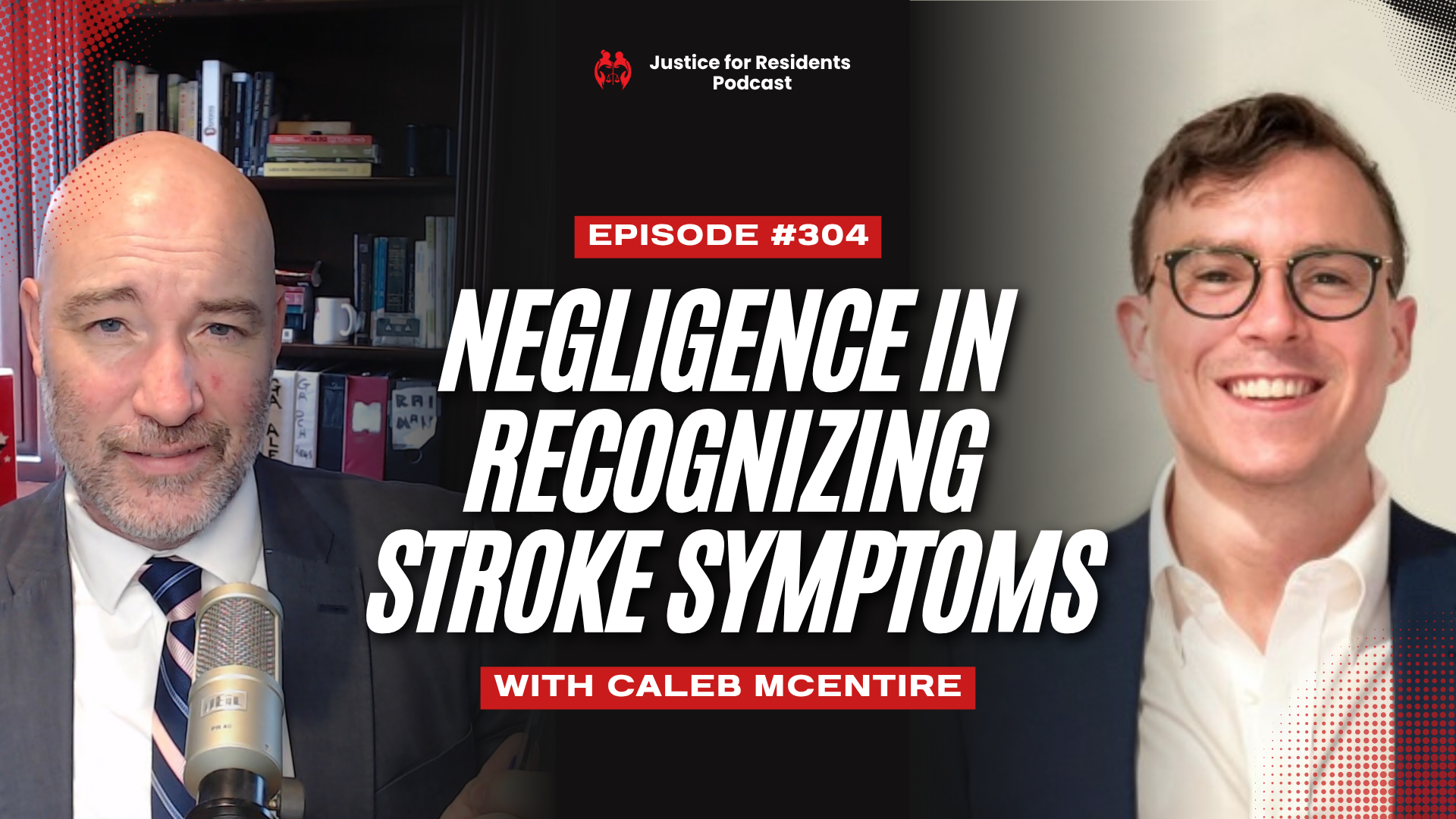


Could a nursing home resident suffer a stroke while staff fail to recognize the warning signs? Delayed recognition and treatment can lead to permanent disability or death. Knowing when a missed stroke crosses the line into negligence is critical. In this week’s episode, nursing home abuse lawyer Rob Schenk welcomes guest Caleb McEntire to talk about stroke symptoms, nursing home responsibilities, and when a failure to act may be negligence.
Schenk:
When a stroke occurs, every minute matters, and that’s because time is brain. This week, we break down the warning signs of stroke and long-term care, why fast diagnosis changes outcomes, and when failing to recognize symptoms may be negligence. I’m Rob Schenk, nursing home attorney, and this week I’m talking to neurologist and Harvard professor and wild berry forager, Dr. Caleb McEntire. Stick around.
Intro
Schenk:
I gotta say that the opening jingle almost sounds like a truck commercial. Gene, can we listen to that again? When you need your mulch from the Home Depot delivered to your house, Ford trucks. Anyway, hopefully as this goes to air, it is June 1st of 2026. In other words, it is essentially a new season new things happening at the Justice for Residents podcast.
We are no longer Nursing Home Abuse podcast, which I feel like was maybe a little bit exclusive, and now we’re the Justice for Residents podcast, which is inclusive. Who’s not for justice for nursing home residents? So this is, again, this is a new season. As I might have mentioned a few episodes ago in our 300th episode, I wanted to not necessarily course-correct, but I wanted to kinda hone in on what this podcast is going to be about over the next season, which is to say, I want to dig deeper into the topics that we discuss, and I want this to be informative to the audience, which I understand now to be attorneys in this industry, ombudsmen, nurses expert witnesses, legal nurse consultants.
So rather than stay at the 40,000-foot view a lot of times, I wanted to really hone in on what it means to take a injury case, an abuse case, a neglect case from, in, in a nursing home from start to finish, and that is my goal, is to really have conversations that, that, that scratch beyond the surface each week.
So I hope that you enjoy it. And so starting that is this week. We talked to Dr. McEntire, but we’ll get into that in one second. As always, though, something that won’t change on the Justice for Residents podcast is the nursing home regulation question of the week. Difficulty this week for your question is gonna s- I’m gonna say easy.
Question of the Week
This is, I think this is an easy one. I think you’re gonna get this. If you get it right, you get two extra pumps of whatever syrup in your latte, frappuccino, whatever it is that you do. Once you get in your Dodge truck, your Ford truck. Now you’re pumped with the, with your theme music. Two pumps extra in your coffee this week.
Under 42 CFR 483.21(2), who is required to be part of the interdisciplinary team that develops the comprehensive care plan irrespective of the resident’s specific needs? Is it A, physical, occupational, and speech therapy? B, a nurse aide that has responsibility for the resident? Or C, a nurse practitioner
And that answer is B. A nurse aide that has responsibility for the resident, according to the regs, is required to be on the interdisciplinary team that develops each resident’s care plan
Guest Intro
So congratulations if you got that right. Now on to the Salisbury steak and potatoes of the episode. We are talking all about strokes and the importance of detection and early treatment, but we’re certainly not having that conversation alone. We have Dr. Caleb McEntire with us. Dr. Caleb McEntire is an assistant professor at Harvard Medical School and an attending neurologist at Mass General Brigham.
His focus is in toxicity of CAR T-cell and other cancer therapies, as well as neuroinfections, infectious disease, and he treats strokes and bleeds regularly during his inpatient hospital and teleneurology work. Outside of medicine, he enjoys hiking, mushroom foraging, and searching for wild blueberries, and we’re so happy to have him on the show.
What is a stroke?
Dr. McEntire, welcome to the show. Can you explain what is a stroke? What’s happening in the body when a stroke occurs?
McEntire:
Absolutely. So people use stroke to mean a few different things. Often we divide stroke into two really broad categories, and I’m gonna use some jargon terms here. I’ll break them all down, okay?
So we say the jargon terms ischemic stroke or hemorrhagic stroke. Basically what this means is ischemic stroke, is there something cutting off blood flow to a portion of the brain? Hemorrhagic stroke, is there bleeding happening in a portion of the brain? I think of these as two completely different entities.
They just both happen to be called colloquially stroke. Okay? So in an ischemic stroke, that’s the kind that we we most often think of when most people hear the word stroke. This means that there’s a blood clot that’s traveled up to the brain. Can come from different areas in the body, could come from the heart, could come from cholesterol in a blood vessel, lots of different areas.
Broader clinical context on recognition of symptoms can be supported by Stroke Symptoms and Warning Signs.
It blocked off a blood vessel, so there’s an area of the brain that’s not getting blood flow and therefore oxygen. In a hemorrhagic stroke, for whatever reason, a blood vessel has burst in the brain, there’s bleeding. Sometimes a hemorrhagic stroke can happen because there was a cutoff of blood flow and oxygen to an area, and the blood vessels got weakened because there wasn’t oxygen to them.
They’re under stress, they’re inflamed, and then they can let blood out. In either of these, you’re going to have a lot of stressors on the b- on the brain, you’re gonna have some inflammation, and you’re gonna have symptoms that depend on exactly where the stroke is happening in the brain.
For a deeper medical overview of cerebrovascular events, you may refer to Stroke Information and Overview (NIH/NINDS).
What is the scope of negative outcomes associated with a stroke?
Schenk:
So what would be the difference then in terms of the negative consequences of either one of those?
Are they different or they’re e- you’re both gonna head to the same conclusion?
McEntire:
So they can have differences in how they develop and change over time, right? If you have a bleed in the brain, then there are different things that can make that worse, right? Taking blood thinners can make that worse.
Having high blood pressure can mean that the bleeding has a stronger reason to continue. Something I point out a lot is that aspirin, while we think of it as a headache medication in many cases, it’s a blood thinner, right? It acts on what are called the platelets in the blood, these tiny tiny pieces that form together, like the bricks that build up blood clots in a lot of cases.
And it makes them less effective. So aspirin is a really effective medication. This is why baby aspirin is used for things like heart disease to stop more plaque from building up in the blood vessels around the heart. But in someone who has a bleed in the brain, that could actually make the bleed worse.
A more detailed clinical reference on stroke pathophysiology and management is available in Clinical Overview of Stroke (NCBI StatPearls).
This is something I’ve seen plenty of times, where someone says, “Hey, I had a really bad headache at home. I took a couple aspirin to help, and then I came on into the emergency room.” We find that they have a bleed in the brain, and the aspirin is probably making that worse unfortunately. Now, in an ischemic stroke, in the kind of stroke where you have a oxygen cut off to the brain, aspirin is really useful because of exactly that quality, right?
It can bust up clots to an extent, stop more clots from forming, so really helpful thing to give. This is one of the reasons it’s so important to present to an emergency room if you suspect a stroke is happening, right? If you suspect a stroke is happening, first thing you do when you come into an emergency room, they’re gonna get a scan, a CAT scan of the head, and that can show us is there bleeding in the brain or not?
If there’s not bleeding, then if there’s a stroke, it’s gotta be one of those ischemic strokes where there’s a cutoff of blood, and that means that we could do things like give aspirin to help out with it. If there’s bleeding, then we wouldn’t wanna give aspirin.
Issues involving severe nursing home complications such as tissue necrosis are discussed in Nursing Home Gangrene and Potential Legal Claims.
Schenk:
Are the… So I guess, a- and I might be wrong about this, but are the symptoms different depending on the type of stroke?
Are we looking for different things if it’s a hemorrhagic s- Am I saying that right? A hem- a- … a hemorrhagic s- stroke or ischemic stroke, are they different symptoms?
McEntire:
So this is the tricky thing is that they can look exactly the same. So say someone has a stroke in the area of their brain that controls language, and it happens that same area of the brain that controls language is pretty close to the area that controls the right arm.
So this is why we use that FAST mnemonic, right? Face, arm, speech, time. So face, if you see drooping of the face, if you see weakness of the arm, difficulty with speech, these are all things that can happen in stroke. And if someone had either cutoff of blood to that speech and arm region of the brain or they had a bleed in that area, in either case you could see drooping of the right side of the face, weakness of the right arm, and difficulty with speech.
A lot of this is because it’s on the left side of the brain. Left side of the brain controls the right side of the body, and vice versa. It crosses over. So they can be pretty sneaky like that. If you have a bleed or a cutoff of blood in that area, they can look just the same unless you get that CAT scan that can show you, hey, is there blood in that area?
For cases involving systemic infection progression, see Nursing Home Sepsis and Legal Options.
What are the telltale signs of a stroke?
Schenk:
So FAST as a test, as an assessment, is good at telling whether or not there’s a stroke, meaning either cutoff of blood or a bleed, but it can’t tell you w- which one of those it is.
McEntire:
Exactly. I think of FAST as a really good way for people to remember at home what the warning signs are for, hey, this might be a stroke.
I should go into the emergency room so they can do some more advanced workup and help us figure out what’s going on. So that’s if you’re seeing drooping of one side of the face, if you see weakness of either arm, difficulty with speech, so someone not able to understand speech or speaking in what sounds like gibberish.
Any of these can be signs of stroke.
When infections escalate to critical conditions, you can review Septic Shock in Nursing Home Neglect Cases.
Schenk:
Would, would you qualify those as the primary symptoms? Or you mentioned headache earlier “Oh, I’ve got a headache. I’m gonna, I’m gonna go to the hospital,” whatever. It… Are we… Are there more that, that follow under the umbrella of symptoms?
McEntire:
Yeah, absolutely. So headache does tend to be more pronounced, often more severe in people who have a bleed in the brain compared to a cut-off of blood in the brain, one of these ischemic strokes. That makes sense if you just think about it from a, taking a step back from all the medical jargon and everything, just from a common sense standpoint.
If you have bleeding in the brain, that’s building up pressure, right? Just if you imagine if you had bleeding in your arm or your leg, there can be pressure that builds up there. So that’s gonna cause some pain and stretching of the linings around the brain. So you can have a really bad headache, and a phrase we sometimes use in medicine is the worst headache of life, right?
So someone who comes in and says, “Man, doc, I’ve got a pretty bad headache,” that’s one thing. Someone who says, “Man, boom, all of a sudden I got hit with just a thunderclap of the worst pain I’ve ever felt in my head,” that’s really indicative of a bleed in the brain in many people. Okay? So having that really bad kind of headache can point us more towards blood but we’ll still need to do a CAT scan to take a look for that.
For guidance on documentation and access to records after injury, refer to How to Obtain Nursing Home Medical Records After Injury.
Schenk:
Does, is that the case for anybody? If a 25-year-old presents to you versus a, an 85-year-old presenting to you with the worst headache they’ve ever had, are you gonna, I- are the… are there classes or groups of people that would be more at higher risk for the stroke than others with respect to- how you evaluate the symptoms?
McEntire:
Absolutely. You are asking the right questions here, I gotta say. So we do think a very different very different lists of problems that could be happening in those different groups of patients. An 85-year-old who comes in, we’re gonna be thinking much more of a stroke, whether that’s bleeding or a blood clot.
In a 25-year-old who comes in, still possible, right? We always wanna keep an open mind and do the diagnostics. That said, there are other causes that we would think of as well. So for instance, people who use cocaine, that can cause what we call vasospasm, so a tightening of the blood vessels in the brain.
That can sometimes cause bleeding in the brain. So it can cause a stroke because of the cocaine use. And people who are young can also have autoimmune attacks on the blood vessels or just this kind of spasm of the blood vessels that can cause pain as well. Those can happen in older adults as well just slightly more common in younger.
So we would think of all of those things. The bottom line is if someone comes into the emergency room with this kind of symptom, worst headache of life, facial droop, doesn’t really matter the age, we’re going to get the testing to make sure that we look at the brain itself and the blood vessels in the brain to see if there’s a clot anywhere or if there’s a bleed anywhere.
Even if in a younger person it’s less likely, we always wanna err on the side of caution.
To understand liability and financial responsibility in neglect cases, see Who Pays for Nursing Home Neglect Injuries.
How are strokes treated once identified?
Schenk:
When someone is positive for the symptoms of a stroke, let’s say that a f- a frontline caregiver at a nursing home, for example, a nurse has done a FAST assessment and there is facial drooping, there is, speech impediment.
Typically, what’s the time window for we gotta get this person somewhere? What how long do we have to mess around?
McEntire:
So that T in the FAST mnemonic is a really important part. That’s time. A phrase we often use- use in neurology is time is brain, right? When someone’s got a stroke, if they’ve got a blood clot in the brain, we need to get that clot out of there as soon as possible.
So if someone has a blood clot in the brain- We have a couple time windows we can look at. One of them is we have clot-busting medications that we can give, and these are beyond just aspirin. These are things that we can give into the vein that help bust up clots in real time. So if there’s an existing one in the brain cutting off blood flow, it can go in and make that clot dissolve.
That we can generally give within four and a half hours of what we call the last known well. Last known is the last time we’re sure that the patient was acting normal, didn’t have these symptoms. So for instance, someone who fell asleep at night, woke up with their symptoms, their last known would be last night, right?
Because they… No one was seeing them having symptoms or not while they were asleep, presumably. Someone who comes in and says, “I was, with my family and then an hour ago my face started drooping,” we have a really clear one. So that’s about four and a half hours for that clot-busting medication.
Now, the advanced, what we call neurointerventional teams, so these folks who do procedures to help with strokes, they can also do a clot retrieval. So going in with these very fancy machinery very fancy devices that can actually pull the clot out physically. Those can often happen within 24 hours, so you have about a day window.
Clinical discussion on skin integrity issues in long-term care can be found in Caring for Skin Tears and Burns in Nursing Homes.
That said, once you’re getting towards the end of that, there’s a lot more decision around, looking at these advanced imaging studies that can help tell us is there utility in subjecting someone to the risk of doing these procedures versus is the stroke pretty much already, has it done the damage it’s gonna do?
In which case, not a lot of reason to subject someone to risk, versus is there ongoing damage? In which case we do wanna stop that. The bottom line is get them in as fast as possible.
Schenk:
Is there one of the two… It’s, ’cause it sounds to me that the, these cool things that you’re describing these procedures that you can do the unclot that’s only for the the ischemic I feel like.
Is it like a tougher go if you’re having the other type of stroke, the hemorrhagics? The hem- Say it for me again. What is it?
McEntire:
I know. It’s a tongue twister. A hemorrhagic stroke. Yeah.
Schenk:
A hemorrhagic stroke. Is it, is it- Yeah … is it tougher to ch- even if you, even if the person had a hemorrhagic stroke in the hospital sitting on the table, it’s a little bit more difficult, it often can be.
McEntire:
A lot of our approach towards that is working closely with the neurosurgery teams and controlling the factors that cause the bleeding to continue, right? So the body in general wants to stop bleeding from happening when it’s occurring, right? We have all these systems that help form a scab over if we get a little cut in our arm, all of these normal things.
Now, if someone’s on blood thinners if someone, if a patient has, say, AFib, this abnormal heart rhythm, and they’re on a blood thinner like apixaban or Lovenox an- any of these blood thinners, we have reversal agents that we can give for those if someone has a bleed that basically take away the effect of that blood thinner so that the blood can do a better job of clotting.
We always try to lower the blood pressure, so there’s just less pressure pushing the blood out from whatever vein or artery it’s coming from. And if the bleed is large enough, we can talk with neurosurgery about helping to go in surgically to relieve the pressure by removing some of the blood or by doing a surgery that would, for instance, remove a flap of the skull to allow more room for expansion without putting pressure on the brain itself.
So there are still things that we can do. There’s less in the way of specific interventions where we give a medication that, boom, stops the bleeding. But there are a lot of ways that we try to essentially enable the body to clot that blood off itself. Because in these cases we often don’t know, is it w- i- in an ischemic stroke we might see there’s a single clot, let’s try and pull that out.
In these hemorrhagic strokes we might not know, is it one vessel that’s bleeding? Is it a lot of microscopic vessels? Could be a little harder to pinpoint.
For broader insight into missed warning signs in care settings, refer to Silent Signals: Care Omissions in Nursing Homes.
Schenk:
But if I understand it correctly the… if we can get that individual e- either way to a hospital within 24 hours I guess between zero hour or the- the time of the stroke and 24 hours it’s more likely that you can help that person.
McEntire:
Absolutely more likely, yeah. And e- even with hemorrhagic strokes too, the sooner you get them in, if there is a circumstance where we can identify a specific bleeding blood vessel, things like if an aneurysm burst, in those cases there might be interventions that we could do to plug up that bleed.
Schenk:
This might be a strange question, but in your experience, is there anything that the symptoms of a stroke get confused for? Any other clinical condition like, “Oh, it wasn’t a stroke, it was XYZ?”
McEntire:
So that’s a really good question, and actually this gets into an area of research that I do do a bit of on the side in what’s called Bell’s palsy.
I don’t know if this is something you’ve heard of before, but Bell’s palsy is a pretty common condition where one side of the face can droop. And this can be caused by swelling or inflammation of the nerve called the facial nerve that controls the muscles in the face. It can also be caused by a few other things like Lyme disease in folks who live in areas where there are, th- there’s Lyme and ticks.
Lyme disease, a really common cause of what we call facial palsy, just meaning this facial weakness or droop, and that can look really similar to the kind of droop that happens with stroke. Now, the droop in a Bell’s palsy or Lyme palsy compared to a stroke, there are some differences. In a Bell’s palsy you’re having this facial droop because the facial nerve is inflamed, and that affects the whole face.
That includes the forehead and eyes. In a stroke, it’s occurring in the brain, right? You have this bleed or clot in the brain, and the brain has essentially a few backup systems that help control the facial droop so it’s not the whole face. So it’s just usually the lower part of the face, like the mouth.
So these can look very similar, and in some people those differences can be subtle. In general, if you’re having facial droop, even if you see that eyebrow and eye are affected, get on in, get a medical provider to assess it.
Schenk:
Yeah, ’cause that, g- guess that goes to where I was headed towards. If we’re, if we are in a nursing home setting, we have a resident who is, it, just by their age and clinical condition probably at risk for a stroke, if you see a facial droop, it would not be appropriate to be like, “Ah, it’s just Bell’s palsy, let’s not worry about it.”
No, it’s a, this is a, we gotta act quickly regardless.
McEntire:
Exactly. The way I think about it is, look, the worst that happens is you bring them in and the ED provider says, “Ah, you just got a Bell’s palsy. You’re good. Get on outta here.” The best that happens is you catch a stroke early on and stop something bad from happening.
Schenk:
Exactly. Dr. McIntyre, we really appreciate you coming on the show and sharing your knowledge with us today.
McEntire:
Of course. Thank you so much for having me. It has been a pleasure.
Schenk:
I never want to take up too much of my guest’s time. I’m super happy that they agreed to come on the show for any amount of time, but I don’t wanna overstay my welcome.
So I wasn’t able to ask Dr. McEntire what, where he forages for mushrooms or where he goes for his wild blueberries, or whether or not he makes pies or cobblers, or perhaps jam or syrup with the wild berries once he’s found them. If you want to get in touch with Dr. McEntire and ask him that, or talk to him about his work, his expert work in nursing home cases or malpractice cases, he can be reached at his email, which we’ll put into the show notes.
Folks, I hope that you found this particular podcast entertaining. I hope that you stick around for more episodes of the Justice for Residents podcast. New episodes of the Justice for Residents podcast come out every single Monday. If you have an idea for a guest that you would like for me to talk to, please let me know.
If you have an idea for a topic you would like for me to talk about, let me know that as well. Please and subscribe where you get your podcasts from, ’cause that’s gonna help put this podcast in front of other people. And with that, folks, we’ll see you next time.
Caleb McEntire’s Contact Information: