


Cross Examination at Depositions
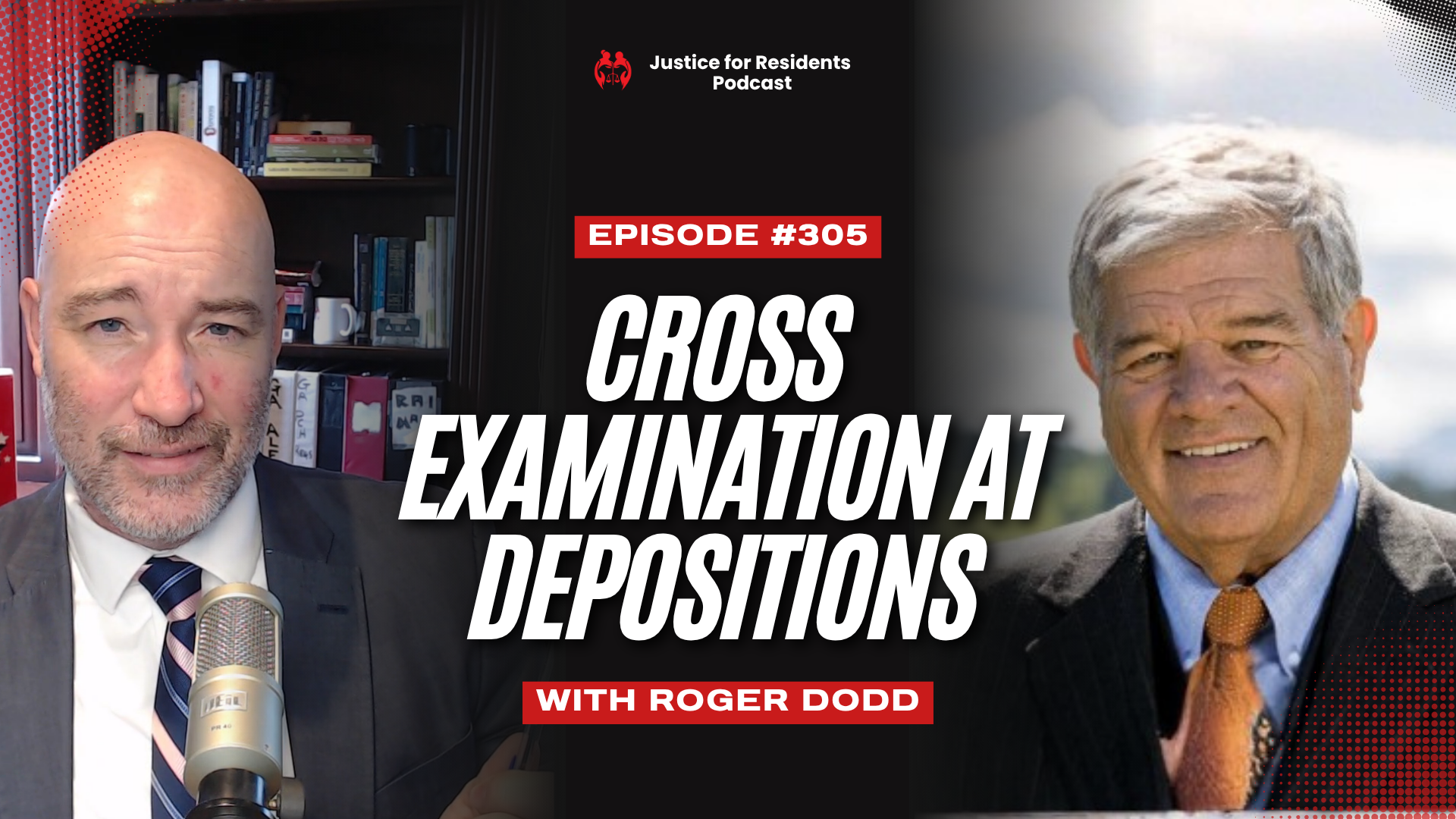


Should you save cross examination for trial, or use it during a deposition? The right questions can expose weaknesses, lock in testimony, and change the course of a case. Knowing when and how to challenge a witness is a valuable skill for any litigator. In this week’s episode, nursing home abuse lawyer Rob Schenk welcomes guest Roger Dodd to discuss effective cross-examination techniques during depositions.
Schenk:
Some lawyers, like me in the past, take depositions to learn the case. Others take them to win the case. That latter technique is what we are here about today. I’m Rob Schenk, a nursing home lawyer, and this week I’m joined by legendary trial attorney Roger Dodd to discuss cross-examination during depositions and why it leads to stronger, cleaner testimony.
It all boils down to essentially what Ike used to say, that planning is essential, but plans are useless. And that’s Dwight Eisenhower, that’s not Ike Turner. Stick around.
Intro
Schenk:
Gene, I still feel like it’s a, it’s the intro jingle, it still sounds like a truck commercial, so maybe we can really try to change it around a little bit for next week. Folks, I’m excited about today’s episode. We’re … And the people working on the house next to me are also super excited as well, but as I mentioned at the top, we are having a conversation with Roger Dodd about cross-examination, and one of the reasons why I wanted to have him on is because he has written an updated fourth edition of the Cross- Science of Cross-Examination book, which I have the second edition.
I thought I had the third edition, but I have the second edition. All the editions have the seal of approval, but if you are interested in what we talk about today definitely get that new edition. According to Roger it’s gonna, it’s gonna be the best one. If you want homework for this episode, I recommend that you go back and listen to a few episodes first.
You can go back to episode 224, which we had Roger on the first time. This is back, way back in May of 2024, so it’s been two years just about, talking about cross-examination depositions, where we talk about from a 40,000-foot view. We also talked in episode 222 with Kate Hughes, deposition strategies that’s more specific to nursing homes, as well as in episode 242 with Don, Attorney Don Smith.
Guest Intro
Great nursing home-specific episodes concerning depositions in those cases. So be sure to check those out. If you’re a true gunner and you want homework, check those episodes out. All right, time to get into the meat and potatoes of the episode. Roger Dodd is a nationally recognized trial lawyer with offices in Georgia, Florida, and Utah.
For more information about legal services and clinic support resources, visit Dodd Law Clinic.
He has practiced for decades in personal injury, wrongful death, criminal defense, and family law, and has taught trial advocacy to lawyers and judges in all 50 states and internationally, and most recently in Colombia, South America, and he’ll talk about that in a second. Roger, welcome back to the show.
What is an x-exam at depo like?
How are you defining cross-examination? Because one person’s cross-examination is another person’s awesome direct.
Dodd:
Yeah, it’s interesting. Rick Friedman and I were talking on the phone literally today. His cross style is very loose and kinda rambles around and takes a lot of, I think, takes a lot of chances.
But as he does it brilliantly. He gets verdicts one after the other, and he definitely has his own style. The reason we were talking, we’re doing a cross-examination seminar in Colombia, South America of all places because they want to change the way they cross. And my style is very Let’s stay in control.
Let’s stay in tighter control. Let’s do the testifying. The witness is only to say yes, and we move on. But look, you have to have a style, and you have to have a system that works for you. Mine is very controlled because I think most trials are lost, not won. And so I wanna be under control that I can control.
Voir dire, for instance, you can’t control that. That thing’s all over the place, and you better get used to that because i- if you don’t let it ramble and go sideways, you’re not finding the right jurors. So the things I can control, like cross, I wanna control.
For a clearer understanding of how witness questioning works in court, see Cornell Law Wex: Cross-Examination.
Schenk:
And that makes a lot of sense.
What are the advantages to x-exam at depo?
Schenk:
Control is the name of the game. Yeah. But I guess my question, though, for you is why it w- why would that be a good strategy for you at deposition?
Dodd:
Let’s look at the stats. When I started practicing law, literally 50 years ago, about 25% of the cases went to a jury. It was not unusual for us to not settle a case till we struck a jury and looked at the panel and said, “Okay, that looks pretty good for plaintiffs,” or it doesn’t.
That affected the value of the case. Now the statistics, generous statistics, 1% of cases go into a jury. Don’t waste, I’m saving it for trial, I’m saving it for trial.” That’s one penny out of a dollar. That’s not enough to save. You have to get in there, you have to pin them down, you have to go ahead and do your cross for two reasons.
The first is to get the admissions you can get. I know you like to talk about, “I get bullet points, then I can apply it,” and you do it wonderfully. I want to get those bullet points, but I also want to show the other side your witness is not gonna survive. I’m gonna tear him up today. You go home and try to fix that.
Now, if you fix it, you’re giving me two versions, not one.” I think I’m gonna bet on me on that situation, okay?
An overview of litigation standards, advocacy practices, and trial resources is available through the American Bar Association Litigation Section.
How do you mitigate the drawbacks?
Schenk:
That, that is, I feel like the largest pushback that I get when I tell people that I follow the Roger Dodd method of deposition is you’re just giving the person- An opportunity to cure whatever defect they had in their testimony, but that’s the perfect response is then I’m gonna get…
Then I’m, then I have two different witnesses. I’ve got the- You bet … oh, okay, this is if this is how you wanna say it now, I locked you in at depo, right? Okay, so I understand the idea then is that the chances of us going to trial are slim, so you wanna get your hits in while you can, and even if you do go to trial it’s even if they cure, it’s probably not a true cure.
What about the attorney, and this was me for a long time I don’t really need to know the case. I can just go into a deposition and ask why, what next, why, what next, why, what next for the seven hours in Georgia, and that’ll do me.” W- what would you say to that person about why they should think about preparing for the deposition as a cross-examination rather than a f- a quote, unquote, “fact discovery deposition”?
Dodd:
Inefficient. That’s the word I give to lawyers who tell me that’s what they’re gonna do. Inefficient and outdated. 20 years ago, we all did a form of that. I was already getting away from that ’cause you didn’t have enough time to tell me everything you know about this case kind of deposition. We’re plaintiffs’ lawyers.
We’re not billed by the hour. We, if you wanna be the insurance defense guy, sure, do that deposition, bill your seven hours, go home, be miserable, and, that’s life. We have to be more creative, and what that means is we create more information per hour than the other side does. We have to do that.
If we don’t do that, we’re not getting verdicts so I’m not in favor of inefficient depositions. Are there times? Yeah, there’s time. We just did a military court martial. They have limited discovery. The judge I thought was very restrictive with that and I get why. He was gonna protect his guy.
And so we had to do, at trial, we had to do some open-ended stuff. I was not happy with that.
Options for resolving claims outside of litigation are explained in Settling a Nursing Home Abuse Case Outside of Court.
Schenk:
I was gonna say, I was gonna ask just literally, like, how did that make you, it made you shake a little bit to ask an open-ended question at trial?
Dodd:
In a perfect world, it works perfectly.
Yeah. We’re not in a perfect world. We’re just not. And when we knew we were gonna have to do it, I had two other lawyers with me we had three defendants. They said, “You want us to go first? We know this isn’t your style. You can listen to mine, and we’ll go from there.” Very reasonable analysis, but my choice was, “I’ll go first.
I’ll get him talking. I’ll hear a spontaneous loop. I’ll give it back to him, then you all are gonna have more to work with later on.” And that worked out just fine. If you ask my druthers, I’d rather not do that, but if we’re not flexible, then we need to get out of the courtroom.
Question of the Week
Schenk:
Hey, folks, I just wanna interrupt this program for the Nursing Home Regulation Question of the Week. I know that’s not how we normally do things on the Justice for Residents podcast, but I wanted to shake things up a little bit by moving the question a little bit down into the episode so we can start the interview faster.
I feel that of the six people that watch the dirty half dozen, a lot of, half of you drop off after the first 20 seconds, so I think that might be because I’m not getting to the interview fast enough. Who knows? Or you hate my guts. Either way, I’m moving the question to the interview. Nursing Home Regulation Question of the Week, difficulty level I’m gonna say this week is medium.
If you get this right, you get to match any two colors. You wanna wear navy blue and black or brown and black together? It’s okay. It matches. It looks good on you. It looks good on you. If anybody says anything funny about it, you tell them that I said that you could do it. All right.
That’s only if you get it right. So here we go.
Under 42 CFR 483.21a1i, a baseline care plan does not have to be completed if A, a comprehensive care plan is developed within forty-eight hours of admission, B, a comprehensive care plan is developed within seventy-two hours of admission, or C, the resident declines to have a care plan
And that answer is a baseline care plan is not required if a comprehensive care plan is developed within forty-eight hours after admission
Why does cross-examination force better preparation?
Schenk:
I feel like, at least in my experience, an advantage to Treating the depo as a cross-examination is that it forces the preparation. So me, as a younger lawyer where I came in I don’t know the case, I’m gonna learn about the case at the deposition, I could go in without any prep because, I’m learning as I’m asking the questions.
Yeah. With the cross-examination deposition I have already constructed the ca- I have to think about themes. I have to think about- Exactly … the, w- how I’m going to use certain vocabulary. All that is already in the can before I get there. I’m not saying that I don’t learn things at the deposition.
Sure. But man I went from no prep to I’ll take a week if it’s an important deposition. I’ll be a full week- Look at that … to prep. Yeah. Absolutely.
Dodd:
Listen, Rob, you’re learning better if you’re already prepared. You know your documents. You know the language. You know the themes you wanna give.
Now you’re listening to any response into that matrix. You’re already putting it into a system, and I, at least for me, frees me up to be very creative with my word and enjoy choices. I don’t know why, but just recently we had a witness in deposition who said she believed in acupuncture, and that was fine.
I don’t know that it gets to trial, but I said, “So you pay someone to intentionally stab you?” Now, that opened up the door for her to say all kinds of things about how prejudice I was and what have you and what have you, but it was all in our theme. It was all moving in our direction because I was listening with our theme in mind.
Discussion of nursing home case timelines and how long litigation typically takes can be found in How Long Nursing Home Lawsuits Take to Reach Trial.
Constructive Cross: Teaching through the witness
Schenk:
That makes sense. You, a- and you get to try out themes, like maybe you have more than one vocab that you wanna use. You bet. I know I know and I, and it’s strange I thought about you as I was doing this at a deposition for me a couple months ago, where I do the, I think it’s called constructive cross, and I’m sorry, my brain is slipping, where I have the deponent- Oh, that’s exactly right
Who is a nurse, teach me what the document is. If it’s a care plan “So on the left panel, this is the risk area.” “Yes.” “On this, the middle panel is the…” And you, and so the, if there’s any issue, sh- she as the deponent has already instructed the jury. So that’s definitely something that I love to do.
Creating trial exhibits during depositions
Schenk:
But I was gonna ask you in your mind at deposition, are you trying to set up exhibits that you would use at trial? Like in other words, are you creating exhibits at deposition?
Dodd:
Yeah. The answer to both those questions is yes and yes. We are trying to make sure that we’re gonna get documents in, demonstratives in, physical evidence in.
We go through the authentication process, we go through the foundation process, so at trial we already know that’s in. We don’t have to worry about that. Or even more important, we know we have a problem there, we’re really gonna have to be on our game to get it in. And as far as creating, yeah, I love even Zoom depositions, I love having a blank page, and let’s start creating the scene.
Let’s figure out where the chair was in relationship to the door.
Schenk:
Do you ever get pushback on that? So s- every once in a while I’ll have attorneys, they’ll say, “We’re not gonna create exhibits at trial. I object. This is not the point of today.” Like, how do you react to that pushback?
Dodd:
The answer is, if you’re instructing them not to do it, then you instruct them to do it. We’re gonna then take a pause, ask the judge to rule on this, ’cause this is testimony. Demonstrative evidence by definition is that evidence that helps the jury, the fact-finder, understand the testimony. I’m just asking him to explain it better, that’s all. And if it takes a drawing, then it takes a drawing. Takes a photograph.
Zoom Depositions vs. In-Person Depositions
Schenk:
And you, and if I understand you correctly, at least from the last podcast, you’re, you are, you, unless there are certain exceptions, you are completely on board the Zoom deposition. You’re, you, there are advantages to in-person, but you don’t mind the Zoom.
Can you talk about that a little bit?
Dodd:
Yeah, I don’t know why I flew so many millions of miles and didn’t understand Zoom. That got past me. But COVID made me learn it, and it made me get better, and now I would just as soon do a Zoom deposition as anything. Now, historically, this was 30 years ago, 35 years ago, I had a judge order me to take a telephone deposition with no screen, no nothing, just verbal, because the witness was in Turkey and you could hear jet planes taking off.
He was stationed in Turkey. His testimony’s gonna be 15 minutes, that’s all. And I fussed and fussed at the judge about, “I can’t see his face. I can’t get the nuance, blah, blah.” I argued for 30 minutes. He said you’re telling me everything that could go wrong, not what has gone wrong.
You take the deposition, let me know how it goes.” I take the deposition. We get great stuff. We introduce it into trial, bench trial, and the judge says, “Okay, it’s coming in. Good. We like it.” Calls us both to the bench and says “Mr. Todd, you wanna reexamine your position on telephone depositions?”
And he’s passed away now, but until he passed away, he would go to bar functions, I’d run into him. Last time was in Atlanta, and he would tell that story to anybody who would listen- … about how he taught me how to take a telephone deposition.
For insight into why certain nursing home cases proceed to court rather than settle early, see Why Nursing Home Cases Go to Court.
Schenk:
That’s amazing. I couldn’t even imagine. I g- I guess he was on a military base, is that what you said?
Dodd:
Yeah, he was stationed i- in the Air Force, and you literally could hear jets in the background taking off.
Schenk:
Wow.
Dodd:
And we had a little bit of difficulty with that, but the other lawyer was fair. When the noise got too loud, he’d say, “Wait a minute.” He was fine with it A- and as the judge said, we’d all do better if we just do it and quit- Yeah arguing about it.
Schenk:
Yeah.
Dodd:
Just get up and do it. That’s an important lesson.
Planning is Essential, Plans are Useless
Schenk:
Yeah. And then I think, and this kind of piggybacks on what you’re talking about with these Zoom depositions, is that kind of like you’re, when you have in-person, you’ve got your papers, you can do them in any order you want to.
It’s like boom, like I’m, and I’m marking the exhibit. But it’s more freewheeling. But again, with the Zoom, it requires a good Zoom requires a lot of preparation. You have to be, you already have to be ready. And I think it’s and this is what we talked about last time, that planning is essential, plans are useless.
And the real education in the process is during the planning, right? Y- you might not use that exhibit or whatever, but the fact that you got it prepared before the depo and thought about how are you gonna use it, that’s the battle, right?
Dodd:
Absolutely. And I, even to the extent I send them ahead of time to the court reporter or the videographer, whoever is in charge of that, and to the opponent. And people say, “You’re showing them your evidence.” Okay. Is the evidence gonna change?
Schenk:
And if they’re worth their salt, they already know what the exhibits are gonna be, right?
Dodd:
They know 90% of it. I had a deposition several years ago. A nice young lawyer, brand-new, really well-prepared, and he said, “I thought I was prepared, but you taught me about this.”
And he picked one thing out that I taught him a- and it was a little obscure fact, and I said, “If that’s all I taught you you’re gonna be one hell of a lawyer.” I, he, the guy was prepared, and that’s the key to it. That’s the key to everything.
Schenk:
Yeah.
Dodd:
Speaking of- It’s not the presentation. They always wanna say you really presented that well. Yeah, mostly I was prepared.
New Edition of The Science of Cross-Examination
Schenk:
Speaking of education, though, speaking of being prepared, can you walk us through any of the, what the changes are, what we can look forward to with the new edition of your book, The Science of Cross-Examination?
Dodd:
Yeah. I appreciate you asking that. That fourth edition was probably the last one for me, and honestly, it was a work of great love because we’d been at this for so many years.
I was never pleased with the third edition, the organization of it. The content’s great. The way the publisher put it together, and I didn’t have a big enough vote then just didn’t make sense, and I don’t think a trial lawyer could follow it. The fourth edition reads the way a trial lawyer would read it.
It makes sense. You say, “Wait a minute, I have to look this up,” you have a pretty good idea where you’re going right away. I see. And that’s the real key to it. Some new concepts, new examples, but the organization, because I don’t know about you, I carry it into trial, I gotta pull it. And it’s always on a 15-minute break.
You get- Whatever you find in a book, you have to find 15 minutes.
Schenk:
I could tell you that again, it’s- it’s over my shoulder. That book, I’ve dog-eared it, I’ve tabbed it so I’m looking forward to seeing it. I’m gonna get the new edition. I’m looking forward to it.
I also have the other one that you did, I believe with your son, if I’m not mistaken, the w- the d- Yeah … the- the cross-examination depositions. That’s also a great book. I know that you say you’re done, but I think the fifth edition needs to incorporate the depositions book. So I’m just throwing that out there. That’s the fifth edition.
Dodd:
I appreciate that, and we are working on the next edition of the deposition book.
Schenk:
Okay.
Dodd:
We’re probably nine, 10 months out from that. And we’re gonna add some direct chapters, direct information, because part of it is because of the South American experience, they don’t have cross in certain trials in certain jurisdictions.
And so what we’re gonna do is add in some direct. For Americans, it’d be direct. But some of the techniques that work directly are just fine. We just have never talked about them before ’cause we were concentrating on cross.
Schenk:
I see. I think we talked about this as we were communicating to schedule this episode, but I spent some time in a part of Colombia called Armenia.
Oh. And it’s beautiful, it’s a beautiful area of the country. It’s remote. Yeah … and it was such a good time. Medellín, I think, is where you said that you were gonna be. We were- We will. Yeah, Medellín was, is a cool city. It’s not like it was in the ’80s apparently, from what I understand. It’s a lot, it’s a lot younger, hip, cool, artistic, not … Your, typically your life won’t be threatened, so you’ll have a great experience.
Dodd:
Yeah. We’re not going south in the country. We’re staying north. I understand there’s a dividing line. Yeah. So one of my former students is leading the charge to revolutionize their cross- And so I wanna be supportive, although I gotta admit I’m not looking forward to the flight.
But wanting to be supportive of what he’s doing is important.
Schenk:
I think you got a direct flight out of Atlanta, though.
Dodd:
What they have me on is out of Miami.
Schenk:
Ah, okay. Yeah. Okay.
Dodd:
And I just get stiff. It’s not that I don’t like flying, it’s just I stiffen up,
Schenk:
I hear you. I hear you. Mr.
Dodd I hope you… I wish you safe travels on that. I h- I think by the time this comes out that will have already happened, so I’m sure there are gonna be a lot of better prepared Colombian advocates when this comes out. But again, thank you so much for coming on the show and sharing your knowledge with us.
Dodd:
Thank you, Rob.
Schenk:
Awesome. Folks, I hope you enjoyed this episode of the Justice for Residents podcast. If you have an idea for someone that you would like for me to talk to, please let me know. If you have an idea of a topic you’d for… that you would like for me to talk about, let me know that as well.
New episodes come out every week. This episode was recorded on May 22nd of 2026. I believe that it is slated to come out one of the first couple weeks of June. So if that actually does happen, I hope that you are having a fantastic summer wherever you may be in the world. And I hope and wish that you would leave me some feedback.
Be sure to like and subscribe wherever you get your podcasts from. And with that, folks, we will see you next week
Roger J. Dodd’s Contact Information: