




Getting to the Standard of Care in Expert Depositions
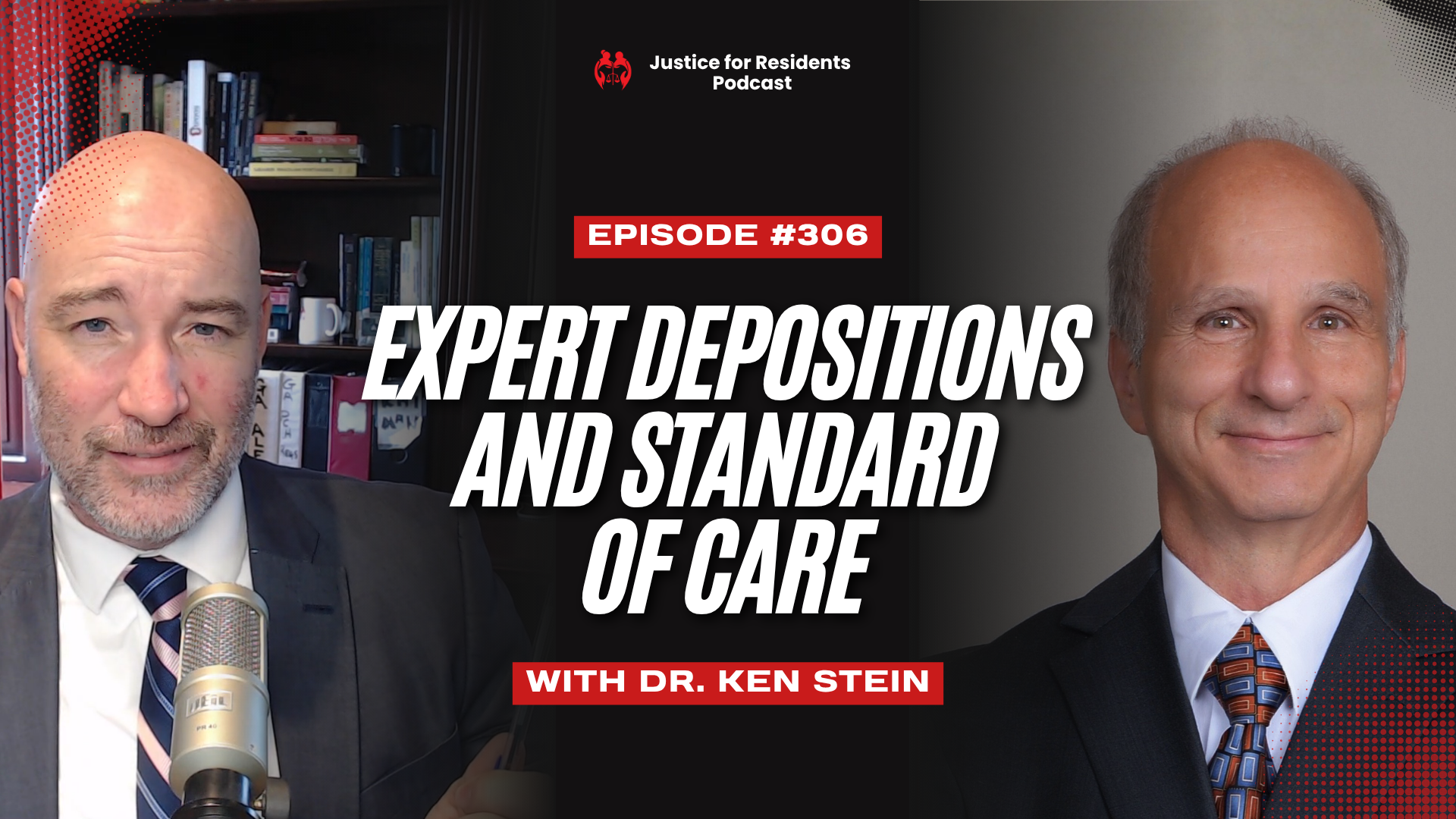


How do you get an expert witness to admit the standard of care? The answer often determines whether a nursing home negligence case succeeds or fails. Asking the right questions can uncover critical opinions and strengthen your case. In this week’s episode, nursing home abuse lawyer Rob Schenk welcomes guest Dr. Ken Stein to talk about strategies for establishing the standard of care during expert depositions.
Schenk:
The phrase standard of care gets thrown around constantly, but what does it actually mean? One doctor’s acceptable practice can be another lawyer’s negligence claim. This week, I’m joined by medical malpractice expert witness Dr. Ken Stein, and we’re discussing how to really hone in on what the appropriate standard of care is in a particular case, whether it comes from policies and procedures, clinical guidance, local practice, or if it soars out of the sky like a bird. Stick around.
Intro
Schenk:
I have to say, Gene, now I think this is the third week in a row where we are just doing different iterations of a truck commercial, but this time it was almost like Sir William Wallace getting in a truck and going into battle type of truck commercial, ’cause I feel like there was a little bit of maybe I heard bagpipes. Folks, if you want homework for this particular episode, that is to say previous episodes that might get you more prepared or more amped for our discussion this week, I recommend going back and checking out episode 226 where I talk to Lance Laurie about using regulations, the nursing home regulations, either the federal or state regulations in trial.
I thought that was very informative about, issues related to standard of care. But for a little bit, we talk about different standards in this episode with Dr. Stein and specifically the theory and the practice of the Kennedy terminal ulcer. So if you want to learn more about the Kennedy terminal ulcer, I would recommend that you go check out episode 232, where I talk to wound expert Martha Kelso, as well as Karen Kennedy Evans, the namesake of the Kennedy terminal ulcer.
Guest Intro
So if you wanna, if you want more information, if you want to learn more, check out those additional episodes. All right, so let’s get into the meat and potatoes of the episode. Dr. Ken Stein is board certified in both emergency medicine and internal medicine, and with a subspecialty certified in neurocritical care.
Graduated from Vanderbilt University of Medicine, Dr. Stein completed his residency at Washington University in St. Louis. Dr. Stein has practiced emergency medicine for 29 years and critical care and intensive care medicine for 27 years. As an expert witness, Dr. Stein has been retained in over 800 cases for both plaintiffs and defendants and has testified over 300 times in cases related to nursing home patient care and personal injury, and we’re so happy to have him on the show.
Tell me about the concept of Best Practices/Excellent Care vs. SOC
Schenk:
Dr. Stein, welcome to Justice for Residents podcast. Tell me about why we should care about all the different ways that we can splice the standard of care.
Stein:
So ultimately, if you’re talking about medical negligence, that comes down to what the standard of care was and was there a breach of the standard of care.
So basically, breach of the standard of care means negligence, which also means someone did something wrong. So to define that, you have to say what is the standard of care? Many people have the thought in their mind, oh, the standard of care is like the gold standard, the ultimate, the way it would be practiced at Mass General Harvard or at Mayo Clinic.
But that’s incorrect. That’s a gold standard. The medical term or the legal term applied to medicine for the standard of care is a minimally acceptable bar. So it doesn’t have to be average. It can be below average and still meet the standard of care. Why do I say that? If you define anything that is below average as being negligent, that would automatically mean that forty-nine percent of all medical care or nursing care is negligent.
So it’s a minimally acceptable bar. The way I like to put it is if you’re a foodie and you like restaurants, it– the standard of care does not have to be equivalent to a Michelin two-star restaurant, but it does need to pass the Department of Health safety inspection. And the standard of care definition varies currently from state to state, and there are some changes which have been recommended as to how that might be adjusted.
In many areas, it’s currently what we call a reasonably prudent standard, what a reasonably prudent physician or a nurse would do in that same or similar circumstance, and by that meaning what is customarily done in a similar situation. The American Law Institute is recommending that it be modified to what is– would be considered competent.
So there might be some more recent changes in the way medicine’s practiced, new guidelines that come out or studies, and there might be more than one particular way to treat a condition. So it’s not always what’s usually done, but if you have experts look at the care that was provided, would experts say that was competent care?
What do clinical guidelines say about the SOC?
Schenk:
If you could somehow wave a magic wand and look at every clinical guideline in existence for a specific situation, and you could extract everything that is congruent, like where all those different guidelines meet at a certain spot, is that not the standard of care?
Stein:
No. To explain that further, the standard of care is always case specific.
So you cannot say what is the standard of care for how to treat diabetic ketoacidosis?” Or, “What is the standard of care for how to treat a patient that has a stage three pressure wound?” Because you have to look at the specifics. That patient with their medical history, their allergies, their comorbidities, their nutritional status, what type of facility are they in?
Are they in a very rural area that has very minimal capabilities? Are they in a long-term acute care facility that has much higher capabilities? So it’s always specific to that person. Plus- There might be multiple factors. So it’s not just a pressure wound in a patient that has diabetes, but it might be the patient has diabetes, congestive heart failure, COPD, malabsorption, is allergic to this, that, and the other medicine.
So you always have to look at the totality. Guidelines Can be used to give evidence to support that the care that was provided met the standard of care. Or it might be that if someone does something outside of all the standard all the guidelines, that it might lend evidence to say the care did not meet the standard of care.
However, there’s a caveat, which is you can follow a guideline, and for a particular patient, you may be breaching the standard of care. Likewise, you may not follow a guideline, and the care may be considered competent, reasonable, and it did meet the standard. So guidelines can help to weigh e- evidence, but they by themselves are not the standard.
For an evidence-based clinical overview of disease processes and complications, see NCBI StatPearls: Clinical Overview (General Reference).
Schenk:
What would you say then if somebody said it sounds to me like what you’re saying is that clinical guidelines c- can’t inform or we can’t get to the standard of care by looking at the guidelines.”
Stein:
My understanding, I’m a physician and not an attorney, but I have done quite a lot of medical legal cases, is that professional negligence, medical negligence, is an area other than standard negligence.
For many standard negligence cases, it’s felt that the jury can opine on their own- … from the facts that are provided, was there negligence or was it? Was it negligent for Mr. Smith to leave a hose going across the sidewalk, so when someone else walked, they tripped on it? Because medical negligence requires interpretation of all the medical facts, courts have felt, except in extreme cases, that a medical expert needs to look at the facts, look at the guidelines, look at the situations, and opine on if there was negligence or not.
Now, having said that, if a case comes to deposition or trial, there will… Definitely a trial, there will be e- experts on both sides. The experts will state their opinion. They’ll be examined, cross-examined, and then the jury will need to weigh both of those and see if they are more believing or agreeing with the plaintiff’s expert or the defense expert.
Schenk:
Yes. Thank you for that. And I’m always guilt- not always, but most of the time guilty of terrible questions. So let me ask the question better. So for example, like if you’ve got a case where, it’s maybe it’s a pressure injury case, and almost universally- The c-clinical guidelines wherever you go, whether it’s the National Pressure Injury Advisory Panel or Lippencott’s or whatever it is, turn and repositioning is the best.
The Origin of the Two-Hour Turning Rule
Schenk:
It’s every two hours. It sounds like what you’re saying is it depends. It’s possible that someone might need to be turned and repositioned more often than that, or somebody might need to be turned and repositioned less often than that. It’s… So the guideline, even if we can agree that all the guidelines meet somewhere, it might not necessarily be the center of care because it might not be– it might not cross over the threshold of the minimum amount of work you gotta do.
Stein:
Correct. Now, and you can fact-check me on this, and please do. What I was taught long, long time ago is that two-hour rule came from a nurse many years ago, Florence Nightingale, I believe over in the Crimean War, and it took two hours for her to do rounds and go from one end of the ward, check on every patient, and come back to the first patient.
So it’s not that there was a magical scientific study that said two hours. Fact-check me on that, please. So you have to look at the specifics of the patient. Some patients may need more than two hours. Some may be okay with a… m-may need to be turned more often than every two hours. Some patients may not need to be turned that often.
But it also depends on how well the patient can reposition themselves.
Schenk:
So according to, I think it’s Gemini, I don’t know, whatever I– whatever AI is associated with Google- Yep … you are correct. The two-hour turning protocol originated with Florence Nightingale in 1859. So that’s the… it looks like it’s citing from the National Institute of Health, but I cannot guarantee that ’cause I will have to go in and look, but that’s what it’s telling me.
Stein:
Yeah. So all that means is that two hours was not some scientifically studied proven interval.
Individualized Care vs. One-Size-Fits-All Guidelines
Schenk:
I see. Okay, so we have guidelines. Talk, talk to me about how it might be possible that someone with perhaps either cutting-edge or not necessarily universally accepted practices, that potentially could be the standard of care, even though it’s the minority of perhaps interventions that could be applied.
Stein:
So once again, you have to look at the specifics. You have to look at that patient’s needs. Is there a lot of ex-excess moisture? Are they an extremely heavy patient? Does the facility have the capabilities of having special, specialty beds to minimize pressure. And the guidelines, there might be different guidelines that will give general recommendations, but you always have to try and tailor it to that patient.
So once again, at deposition, at trial, the experts may pull out recommendations from standard guidelines, but you have to look and see if it applies to that patient. A good example, when you just brought up AI, which can be extremely helpful, but I’ve done some AI searches, and they’ll bring up a statement, and then they may have a medical article that it comes from.
And if you look at the medical article, you may see that you’re asking a question about an adult patient, for example, and the article they’re quoting may be from a pediatric patient. So be careful when you’re using AI. Double-check, see what the source is, and you may have some guidelines and articles that conflict with each other.
Now, I don’t know if that exactly answered your question, but please feel free to restate, and I can try and do a better job.
For additional medical background and peer-reviewed clinical discussion, refer to NCBI StatPearls: Clinical Pathways and Outcomes.
Kennedy Terminal Ulcers and the Standard of Care
Schenk:
No you’re doing fantastic. It’s usually my question. But I guess maybe it’s something like I’ve had Karen Kennedy Evans on the show, and Martha Kelso, to talk about the Kennedy terminal ulcer, for example.
And there are some people that say that is an evidence-based concept. Some people say it’s not. And so it seems like in s- in some courts it’s accepted as something factual that can be presented. In some courts it’s not. So I guess that’s kinda my question of just because something isn’t universally accepted doesn’t mean it’s…
does it not– it doesn’t necessarily mean that it wouldn’t meet the threshold or the standard of care in a particular situation.
Stein:
So let me try and phrase it slightly differently in reference to Kennedy ulcers. Kennedy ulcers, if they do or do not exist, are end-of-life ulcers in patients that have terminal conditions, and it’s like organ failure.
You may have people with heart failure. You may have people with hepatic failure, liver failure, with renal failure. So it’s a failure of the skin. It should not come up as something out of the blue that afterwards when the patient develops this horrible ulcer, they said, “Oh it was bound to happen.
There’s nothing we can do about it.” They have to show, from my opinion- that they knew that this was a patient who was at risk for severe multi-organ failure. They were at risk for skin failure, and that they have documented a clear plan that was placed into action of, “We are concerned that this patient may be at risk for a Kennedy ulcer, therefore, we are being ultra-careful.
We are turning them every one hour. We are being extra careful as far as moisture protection and various other things.” Also, is it in one particular area? Is it only on one heel or one calf, or is it across the back? Is it only on one side, which might make you think maybe they were putting the patient more on that side.”
So Kennedy ulcers may or may not exist, but they have to show that there was a conscious effort, that they realized the patient was at risk, and they tried to prevent it.
Legal discussions of care expectations in healthcare and nursing facilities can be supported by Cornell Law Wex: Standard of Care.
Question of the Week
Schenk:
All right, folks, we interrupt this interview to bring you the Nursing Home Regulation Question of the Week. This week, I’m saying it’s medium hard.
Slight difficulty on this one. If y- if you get this right, you are allowed to make one a-hole traffic maneuver guilt-free. Don’t worry about it. But it’s gotta be safe. Don’t do anything illegal. Like, when the cops pull you over, don’t say, “Rob told me to do this.” You get one safe yet a-hole maneuver in traffic.
Don’t let somebody out. Force your way into traffic safely. You can do all that, and don’t think anything twice about it. Maybe you already do, but I feel bad when I do those types of things. So don’t feel bad about it. You get one of those if you get this question right. So here goes
Under 42 CFR 483.21(1), a baseline care plan must include A, payment or insurance information, B, discharge goals of the resident, or C, initial go- goals of the resident. That’s my Southern accent coming out
And that answer is C, initial goals. Every baseline care plan under the federal regs requires many things, but specifically the initial goals for that particular resident
Custom vs. Competent (female heart attacks)
Schenk:
Tell me about the idea of custom versus competence with respect to, for example, female heart attacks in the standard of care.
Stein:
It is known that for many conditions such as heart attacks, myocardial infarctions, that a woman presenting to an emergency department with the exact same symptoms as a man, that there’s a tendency amongst physicians, male and female, to pay less attention to the f- woman’s complaints.
“Oh, you’re just anxious. Oh, you’re just having some GI upset.” Where if it’s a man with the same complaint, they’ll be, “Oh, I’m concerned that’s a myocardial infarction.” So there will be a tendency to not diagnose women as rapidly with a myocardial infarction. There’s a tendency to miss more women.
Just because that’s more common, and that might be the more common practice, you still have to look at the particulars of that case and say, “Was that competent?” If a woman comes in and she has chest pain that’s going up the side of her neck, going down her arm, and she’s a smoker and a diabetic, it would be beneath the standard of care for someone to say, “Oh, I think you’re just upset because you had a fender bender early this morning.”
So just ’cause something may be usual or more common doesn’t mean it’s competent.
For understanding the role and importance of expert testimony in litigation, see Cornell Law Wex: Expert Witness.
National Standard of Care vs. Local Resources
Schenk:
Tell me about the idea of the level of care you might get in the city’s, premier trauma hospital versus a rural hospital. What, w- how do we discuss standard of care where you have one place that, has a lot of resources versus another place where there’s not perhaps as many resources?
Stein:
So once again, the standard of care is specific to what’s going on in that situation, and it’s what we call a national standard of care. So what would be done anywhere in America at a similar situation, similar facility, similar patient. What do I mean by that? If you are in a rural hospital in Alaska and it’s a two-hour flight on a fixed-wing aircraft to the, to Anchorage, and all you have is one doctor, maybe you don’t even have a doctor, maybe there’s just a nurse practitioner in the ER, or if it’s a nursing facility or limited care.
You have to look at what they have available. They may only have one bag of IV fluid for the clinic. So the normal situation might be that we give thirty milliliters per kilogram body weight of IV fluid for sepsis. So a usual size seventy-pound, seventy-kilogram person would get two liters of fluid. If you’re in a small rural community, all they have is one liter, they’re not gonna get that.
Someone has a massive GI bleed, standard of care for a large facility might be that they automatically get transfused using a massive transfusion protocol. If you’re in a place that has limited resources, that won’t be available. So you have to look at what was available, who are the providers.
It would be different what a cardiothoracic surgeon may do as opposed to as if a nurse practitioner who’s evaluating someone that may have an aortic dissection, for example. So you always have to compare apples to apples And so if it’s a r- so when I say nationally, if it’s a hospital or a nursing home and with limited resources, it shouldn’t matter if that’s in Alaska or Florida or New York, it’s based on what they have available.
There may be some local differences related to laws such as pregnancy-related care, for example, but otherwise, it’s based on a national standard.
For a breakdown of liability and financial responsibility in nursing home neglect cases, refer to Who Pays for Nursing Home Neglect Injuries.
From Breach of the Standard of Care to Causation
Schenk:
Okay. So let’s pretend that we’ve established then what the standard of care is. We’ve got to the standard of care. The standard of care in a particular situation is that the resident, based on their specific needs, should have been turned or repositioned every two hours, and that wasn’t done, okay?
So do we have a violation of the standard of care? But how do we get from that to now that person is deceased from septic shock, from sepsis, from infection of the wound because they weren’t turned or repositioned?
Stein:
Let’s say for argument’s sake, like if a patient has been in the nursing home for a month, and they’re supposed to be turned every two hours, that’s 12 times a day for a month.
That’s a whole bunch of turns. If, and I’ve had cases like this, where the attorney said “look, there are three times out of…” What would that be? 1,200 turns, something of that nature. Actually it would be more than that. However many turns that would be, that they missed them three times, that’s why they got the wound.
Getting 98, 99% of the turns, that’s pretty good, as opposed to 50% or 80% of the time they were supposed to be turned, they were not turned, and there are periods where they might have missed multiple turns in a row, so they were left in the same position for eight, 10, 12 hours. You can then say, more likely than not, depending on the particulars of the case, that those breaches, the failures to turn as often as they did, the failures to apply the barrier cream and the cushions, et cetera, led to cause that pressure wound.
The skin is a barrier that helps keep what’s inside the body in, what’s outside the world out, so that all the bacteria that are crawling on our skin don’t end up getting into our bloodstream causing severe infection. When you get to a stage three, and, furthermore to a four pressure wound, there’s an open area that can easily become infected.
There’s also a difference between colonization, where the bacteria are just kinda hanging out there on the surface of the wound, as opposed to an invasive infection, where there’s evidence of cellulitis, spreading of infection, septic shock. If you have a patient that develops bacteremia, for example. So there’s let’s say Pseudomonas is in the blood, and you show that there’s Pseudomonas in the wound, that’s pretty easy to connect the dots and say those are connected.
For a detailed overview of potential compensation and damages in nursing home abuse cases, see Types of Damages in Nursing Home Abuse Cases.
Some people may… patients may have a severe infection in that area that may cause devastating consequences of renal failure, possible death, and they may not get a positive blood culture. Why is that? Blood cultures To be positive, you need to have bacteria that are floating around in the blood at the time that the blood was drawn and put into the culture bottles.
Some patients may never actually have bacteremia. They may just have a severe local infection. Some patients may have intermittent bacteremia. For example, people with bad pneumonia, they’ll have fever spikes or a bladder infection. It’s not a constant temperature all the time. They’ll have episodes where they have what we call rigors, real severe shaking.
And it’s at those– that time when you have patients that all of a sudden they develop a lot of tachycardia, rigors, chills, they’re more likely to have bacteremia at that time. If you draw a blood culture at that time, it’s more likely to be positive. The long story is you try and look at ultimately what led to their death.
Did they die because they were so severely malnourished the wound was never gonna heal, they were in chronic pain, the patient and the family decided they were gonna go for comfort measures only because the wound would, in all likelihood, never heal? Did the wound progress and erode into a blood vessel that led to severe bleeding?
Did the patient end up having bacteremia and septic shock? So you have to look at each individual part and see how they’re connected, and then bring that back to if that wound was not there, if that was intact skin in that area, that local infection, more likely than not, would not have occurred, and more likely than not, the patient would not have died on the date they died.
Schenk:
Very well said. Thank– we can see that you are definitely experienced at breaking things down to brass tacks and talking about it. Again, thank you so much for coming on the show, Dr. Sine, and sharing your knowledge with us today.
Stein:
Hey, my pleasure. Hopefully, we’ll get to meet down there. If you have any other questions you wanna talk about, causation or any other things, it’d be great.
Schenk:
Folks, I hope that you enjoyed the contents of this episode. New episodes of Nursing and Abuse Podcast come out every single Monday. If you have an idea for a topic that you would like for me to talk about, let me know.
If you have an idea for someone that you would like for me to talk to, let me know that as well. If everything goes according to plan, this episode should come out, should be published the week of June 15th. So I ha- I hope you are having a great summer. I hope you have a good holiday this week. And with that, folks, we will see you next time.
Dr. Kenneth A. Stein’s Contact Information: