




Outside the Box Arguments on Beating Arbitration in Nursing Home Agreements
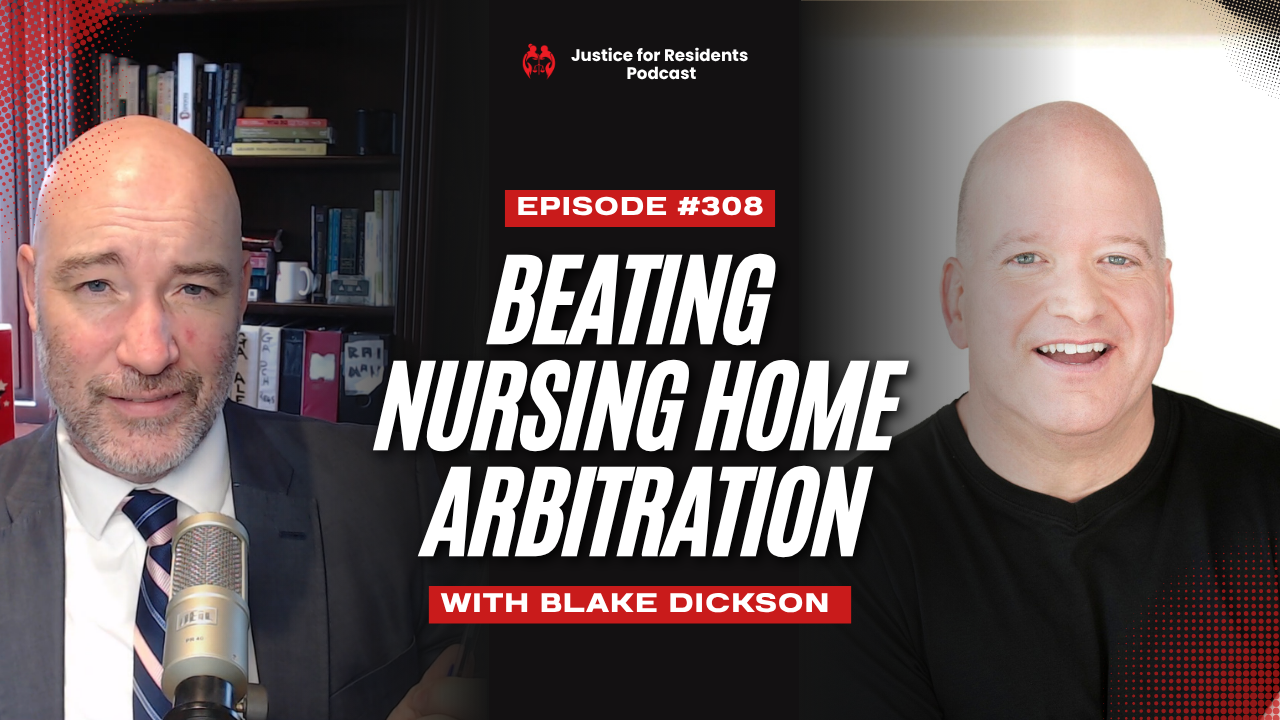


Did your loved one sign away their right to a jury trial without knowing it? Arbitration agreements can make it harder for families to seek justice after nursing home neglect or abuse. Sometimes, winning the case starts with defeating the arbitration clause. In this week’s episode, nursing home abuse lawyer Rob Schenk welcomes guest Blake Dickson to discuss creative and effective arguments for challenging arbitration agreements in nursing home cases.
Schenk:
One signature on a nursing home admission form, or lack thereof, can decide whether a family gets their day in court or gets forced into binding arbitration. This week, we break down some of the off-the-beaten-path arguments that lawyers can use to fight back against forced arbitration. I’m Rob Schenk.
This is the Justice for Residents podcast. This week, I’m talking to Blake Dickson, the lawyer behind Esther’s Law, and one of the few plaintiffs’ attorneys to argue nursing home residents’ rights before the Ohio Supreme Court. Stick around.
Intro
Schenk:
Wow, that’s bagpipes. But still bagpipes meet truck commercials. Like me, I’m hoping that we can move away from the jingle sounding like I should be built for Ford tough. Today, folks, I am excited for the conversation that we’re gonna have with Blake Dickson about arbitration agreements. If you wanna learn more about arguments to fight and keep your cases in court and outside of arbitration, I recommend a little bit of homework, which is episode 217, which was Objecting to Enforcing Arbitration Agreements, and our guest was Attorney Sarah Martin.
And actually that’s September of 24, 2024 is when that came out. And then episode 248, which came out in April of 2025, and that’s, again, Fighting Arbitration Agreements in Nursing Home Cases, and our guest on that episode was Ben Reyes. And those episodes dealt a lot more about the idea of fighting arbitration based on the authority of the person that signed the agreement.
In other words, if the individual that signed the agreement didn’t have a power of attorney or a guardianship or some other type of legal documentation, written documentation then you can argue that it should be tossed, or capacity. If the individual that signed it didn’t have capacity to sign arbitration agreements, then you can get it tossed.
We are not dealing with those arguments today, but if you wanna learn more about those specific arguments, go again to episode 217 and episode 248.
Guest Intro
Schenk:
On to the meat and potatoes of the episode. Blake Dickson is an Ohio trial lawyer who has spent more than 25 years representing nursing home residents and their families in cases involving abuse, neglect, wrongful death, and serious injury.
He has argued nursing home residents’ rights before the Ohio Supreme Court, teaches nation- teaches lawyers nationwide, including myself, on nursing home litigation, and is known for his role in the case that led to Ohio’s Esther’s Law. And I’m super glad that he was able to come on the show and talk to me today.
Does It Matter Which Defendant Signed the Agreement?
Schenk:
Blake, right out the gate, what arguments are you using and finding success that don’t have to deal with the capacity of the resident or the authority of who signed the arbitration agreement?
Dickson:
So you’ve articulated the first one that we always start with.
The second one is the other side of the coin, the defendants. And so number one We look at the arbitration clause and 99 times out of 100, I’ve made arguments that none of the defendants are included. So as you probably know, in order for a contract to be binding, you have to be named in the contract and you have to sign the contract.
And so the first thing we do when we get one of these motions is we file a motion with the court, we ask for a briefing schedule, and we ask for discovery. We get all the documents they gave to the family or the resident, and then we take the admission person’s deposition. You don’t ask the admission person what they said, ’cause they’ll always say I don’t remember what I said to this lady, but we always say X, Y, and Z, and I always do all the right things,” whatever.
You ask her what she knows. So I just finished one, and I asked her about arbitration. I said, “What is it?” She goes, “It’s an informal negotiation without lawyers or judges or anything.” I said, “Oh, really?” I said, “Who’s involved?” And she said…” She didn’t know that arbitrators were involved, she didn’t know the rules, she didn’t know the cost.
So right there you’ve got a bunch. So number one, you establish who she is, who she works for, and who she’s got authority to sign for. “Do you have authority to sign contracts for Springer Clinical Services Limited Liability Company?” “No.” And a lot of times they know the names. Like I’ve heard Springer, I’ve heard ManorCare, I’ve heard CommuniCare.
But when you drill down, “Yeah, but do you know ManorCare Health Services Roman Numeral Four Limited Liability Company?” “No, I don’t know that company.” “And so you and I can agree that you don’t have the authority to bind them to a contract?” “No, absolutely not.” So they’re not named, and they’re not s- nobody signed the contract on their behalf, so they’re…
So that’s a winner right there. Now, sometimes the nursing home is on there, but sometimes it’s so abbreviated that even that’s not valid. ‘Cause as you probably know, you can d- you can contract in the name of your DBA. If you’re Attorney Rob Shank but you do business as, Rob’s Kickass Podcast or, Rob’s Super Lawyer Ability or whatever, as long as you’ve registered that DBA, you can actually enter into a binding contract just on, on the name of your B- of your DBA, and the underlying corporation that registered it is bound.
So sometimes we run into that. Sometimes we got Happy Acres and Management Company LLC did register it, and so if the other lawyer’s smart enough, he can argue that’s binding. But a lot of times it’s… they don’t even do that. The name is it’s not Dover Regional Care Center or Dover Nursing and Rehabilitation, it’s just Dover.
And so what we argue is, look, Dover can have arbitration all it wants, but we’re not suing Dover, we’re suing these six people. A lot of times you have individuals that are owners of the nursing home. We all remember Life Care Centers of America, and Forrest Preston personally owned them.
Arbitration Agreements on Tablets and Electronic Admissions
Dickson:
He’s never been on an arbitration clause. So you get those out. He’s not on it, he didn’t sign it. You get all the corporations out that aren’t named and didn’t sign it. One of the things we’re seeing currently that’s very interesting is, up until recently, mom’s admitted to a nursing home from the hospital on the gurney half delirious, and they hand her a 100-page contract, and the arbitration clause is page 38 in there, and she doesn’t know what’s going on.
Now it’s even worse. They’re handing them a tablet. And so I just had one where they handed mom a tablet. The tablet is 100 pages. You and I are both attorneys. It would still be a task for you and I to read a hundred-page contract. Especially with fine print. As lawyers who read documents all day long, that’s daunting.
As a 72-year-old lady with dementia who’s being admitted to a nursing home from hip surgery, it’s impossible, and there’s no way that she looked at that document. One of the things I just said earlier, I was we were teaching a webinar on this, and I said, I often go into court, and whether it’s the trial judge or the court of appeals, I say to them, ‘Let’s consider the fiction, Your Honor.'”
The fiction here is that Mrs. Jones was admitted to the nursing home with dementia, recovering from hip surgery, unable to care for herself, and they sat down with her and they said, “Mrs. Jones, in the unlikely event that an orderly rapes you, or you fall down a flight of stairs, or you elope out the back door in January and freeze to death, or you drown in a pond, or you get hit by a semi-truck…”
And I always say to the court, “By the way, members of the panel, all real cases that I’ve handled.” We’d like you not to sue us in court. Instead, we’d like you to arbitrate your case with the American Health Lawyers Association, all defense attorneys. We’d like you to pay a $50,000 filing fee, and we’d like you to do this because we know that when we go to arbitration, we win a lot of cases, you don’t get discovery, and the, and if we do lose, the verdict’s much smaller.
Will you sign this document? And I say to the panel, who in their right mind would sign that document? Nobody. So capacity of the plaintiff. Capacity or are the defendants parties? No electronic signature. And what we argued in this recent case.
For a general overview of arbitration as an alternative to courtroom litigation, see Justia Guide to Arbitration.
Schenk:
Let me give you some pushback for a second. With respect to the… And that’s brilliant. I’ve always gone I guess I, I don’t think that I’ve ever used the argument that this person is not a- authorized to sign on behalf of another defendant not on the contract.
Okay. But the pushback on that, do they ever say no, she has permission to, in this instance, she had permission to, sign f- on behalf of all the other defendants in the case”? What do you say to that?
Dickson:
So what you start with is, like I said, you read the names, and if you can think of your typical nursing home contract, right?
You’ve got Happy Acres, but then the management company is Orion Health Services, and then you’ve got another company that is the real owner, and they’re Odyssey Healthcare LLC. And so what I start with is, and they’re rarely really well prepared, even though I’ve done this same depo 500 times, I say, “Can you tell me who Odyssey Healthcare- Odyssey Healthcare Services Limited Liability Company is?” No.
Schenk:
And they have no idea. Yeah.
Dickson:
Yeah. So you and I can agree that you’re not authorized to enter… A- and the, and I phrase it, “Enter contracts, bind them. You don’t have authority to bind this company to a contract. Can we agree to that?” Absolutely. And usually they just give it up that they don’t know these companies.
Schenk:
That other company never comes behind with an affidavit saying, in this instance she did, or et cetera.
Dickson:
So two, two really important points. Number one, and in this day and age, we’re learning to record everything, keep track of everything, and as we’re using AI more and more, we’re learning that if everything’s either a PDF or a Word document and you get it all uploaded, AI can retrieve it later and remind you of good arguments.
Keep track of what they argue during the arbitration phase. Because, when it comes to arbitration, “Hey, we’re just one big s- we’re one big entity. We’re all related. We’re all the same thing. We’re all the owners of the nursing home. Everybody’s the same. Everybody should get arbitration.”
Later when they lose, “Wait a minute. We’re just an investor. We’re just a back, back office management company that helps with payroll. We’re just the…” I’ve had situations where they said, “He’s just an investor. Would you sue him if he owned five shares of Apple?” And I’m like, “I don’t think the guy who owns five shares of Apple gets to dictate what products Apple’s gonna develop.
I don’t think they get to dictate where they’re gonna have their factory.” So keep track of that. But back to your question, they always put that catch-all in there, right? Cor- you know, nursing home and all of its parents, corporations, blah, blah, blah, blah, blah, blah, blah. So I s- I’ve said to many judges, the judge went, “What about that, Mr.
Dickson?” I said, “Judge, let me ask you a question.” When we’re done with our oral argument today, as I’m driving home, I pass the Cadillac dealership as I was coming down to your court to argue this case. If I stop at that Cadillac dealership and I sign a lease for a $100,000 Escalade, and I sign that lease on behalf of Blake Dickson and the good-looking court appeals judge with the mustache, are you bound to that contract?
Additional background on arbitration law and key legal principles can be found in Justia Arbitration Law Cases Outline.
Are you backing me up on that lease? Are you liable for my lease payments? And they usually laugh and say, “Absolutely not.” And I say Judge, you can’t contract by description. You can’t contract by whatever.” Now, to your specific question, if I’ve had the person, the admission person testify that they’re not authorized, let’s assume the company comes in later, which they’re probably not gonna do, I’ve never seen it, but let’s assume they come in later.
Now you’ve got sworn testimony by the person that said, “I didn’t know I had authority.” And then they come in later saying, “Yes, she did.” But you’ve still got the argument that they’re not named in the contract. That’s how you’re on a contract. You gotta be named and you gotta sign.
And if she does say, “Oh, yeah, no, I was authorized to sign on behalf of everybody,” I say, “Okay, tell me where you got the authority.” What do you mean? Is there some power of attorney document? Are you on the board? Is there, so you’re an officer? Tell me where this comes from. That’s where it falls apart, because you know that the admissions person, particularly if it’s not the head of admissions, there’s no documentation.
And follow up again. Send me documentation that Sherry has the authority to bind Life Care Centers of America to a contract.
Why Is It Important to Scrutinize Digital Signatures?
Schenk:
You had talked about this 100-page document on a tablet. M- perhaps the individual has capacity, but they’re still, not like they were when they were 35.
I- and it seemed to me that at least in Georgia, that would fall under not necessarily capacity, but under unconscionability. Is that kind of how you’re approaching that argument?
Dickson:
So we always include substantive unconscionability, the terms of the contract, and procedural unconscionability, the way it was signed, as our arguments.
I feel like they’re the weakest arguments, but I’ve definitely won with them, so we include them in terms of her signing, so number one, we attacked this last one and said whoa. That’s not her signature. That’s her name in a cursive font.” That’s me showing up and typing Rob Schenck on my computer in a squiggly font and saying, “That’s a contract.”
And I, and again, back to, I say to the judges, “Your Honor, so if I stop at the Cadillac dealership and I type your name on the lease, are you bound?” And he says, “No.” So one of the things that’s key is you lock in the admission person to the fact that they have no memory of that admission.
And you do it very, pleasantly. Say, “Hey, how long have you been there? How many… you do five a week. This was three years ago. Do you have a specific memory of this admission?” “Oh, I do.” “Okay.” And then I have a whole series of questions after that. “Okay. What were you wearing?” I was wearing scrubs.
I wear scrubs every day.” “Okay. What was my client wearing?” “I don’t know.” “What day of the week is it?” “I don’t know.” “What time was it?” “I don’t know.” “Who was there?” “I don’t know.” “Tell me exactly, word for word, what she said.” I don’t know that.” “Tell me exactly, word for word, what you said.” Usually you can get them to back off that they have any kind of specific memory of the admission.
For a discussion of how arbitration applies specifically to nursing home disputes, refer to What Is Georgia Nursing Home Arbitration?.
Using Signature Timing Data to Challenge E-Signatures
Dickson:
The other thing that’s exciting, and you and I heard this recently at a seminar we were at, if it’s electronic, you can run a search and you can see the timing of the signatures. So you got nine pages on a 112-page document that were signed in 19 seconds. Now let them argue they read that document to the resident, ’cause obviously that didn’t happen.
So you knock out that the defendants aren’t parties. You knock out that the plaintiff’s a party. You attack the signature if it’s supposedly electronic. And now we move into, in Ohio there’s a wonderful statute about what these clauses have to include. But even if you’re not in Ohio, there is a federal statute, so 42 C.F.R.
483.70is a specific code of federal regulations about binding arbitration agreements, and it has all kinds of good requirements. One of the ones that I think nails them in every case is they’ve got to explain the agreement to the resident in a way they understand, in a language they understand. I’ve nailed a ton of admissions people.
You get them going down the thing, and “Oh, yeah. I have a specific memory and I told her the whole thing,” and whatever. And I say, “Fantastic. Where did you learn to speak Croatian?” What do you mean?” Mrs. Gukanak doesn’t speak English. She’s Croatian, and her family has to interpret everything.
You just told me that you were, you met with her alone and you explained this 100-page document.” I don’t… How would you do that if you don’t speak Croatian? And then she’s nailed.
Question of the Week
Schenk:
We interrupt this exciting episode’s interview for the nursing home regulation question of the week. This week, folks, I think that the difficulty level, I’m gonna say is hard.
It is… This is a hard one. So if you get this right, you get to buy yourself a scented candle for the bathroom that you saw at Target yesterday. Go back to Target, go to the, arguably the largest section of Target, which is the candle section. Buy the one that you want, the nice one. You can splurge if you get this right
Under 42 CFR 43.80, the infection preventionist is required, A, to have a master’s degree or higher, B, to have a bachelor’s degree, or C, to have completed specialized training
And that answer is C. The infection preventionist that the individual that is designated as infection preventionist at the nursing home under the federal regs is only required to have completed specialized training in order to occupy that role.
Schenk:
What do you say, Blake, to the idea that the federal regs are reimbursement? In other words, even if you don’t adhere to the requirements for admitting someone with an arbitration agreement, that doesn’t go to the validity or the devoid ability of the contract. Just goes to whether or not the next resident will be, they’ll reim- they’ll be, the facility will be reimbursed for them.
Dickson:
And I have to say just in general, that is the dumbest argument the defense counsel makes. Think about the federal regulations about bedsores. If somebody enters a bedsore, they have to get g- they have to get care and services to… I’m sorry. If they enter without a bedsore, they have to get care and services to prevent bedsores unless they’re clinically unavoidable.
That has nothing to do with reimbursement. That has to do with the care. Now, I have every one of my experts testify that the standard of care is what a reasonable and prudent nurse or aide would do. A reasonable and prudent person complies with the laws that apply to their job. A reasonable and prudent person in a nursing home complies with the federal regulations.
And, usually you can find out, it’s in the patient care policies. You take the deposition, they’re, they teach them. Why do you teach these if they’re reimbursement guidelines? You teach them because they’re about good care, and you’ve got the Long-Term Care Survey book behind you. There’s stuff in there about the fact that they’re proper care.
There’s all kinds of that. But if you read 43.70, what it says is, if a facility chooses to ask a resident or his or her representative to enter into an agreement for binding arbitration, the facility must comply with all of the agreements in this section. Your honor, the facility didn’t comply with the section, therefore it’s not enforceable.
Now, I will say this. In Ohio our statute is even, it’s worded even better, because it says, “In order to be valid and enforceable…”
Schenk:
Oh there you go. There you go.
Dickson:
So that’s better. But, like I said, the Code of Federal Regulation says, that it has to ha- you know, in that it must comply with all of the requirements.
It doesn’t say anything about reimbursement. It doesn’t say that if you don’t comply, you don’t get paid. It says you must comply. It says the facility must not require any resident to sign an agreement as a condition of admission, and that’s a great thing. I always ask them, “What do you get if you don’t sign?”
Nothing. What do you lose if you don’t sign? Nothing. That makes it a condition of admission. If you’re not getting anything extra, how many people have not signed? Everyone signs. How many people have changed the agreement? Nobody. Come on, that’s a condition of admission. But more importantly, it’s gotta be explained, and they have to acknowledge that they understood it.
Now, I would argue that’s a slam dunk violation of the CFR and you win. If your judge doesn’t like that, you can fold that into your procedural unconscionability argument, and you can say, “Your Honor, the s- they’ve let… the CFR the federal legislature has laid out what they have to do. They didn’t do it.
Why Nursing Home Arbitration Agreements Require Special Scrutiny
Dickson:
That makes it unconscionable.” And you gotta educate the judge and say, “Look, this is a special deal, right? This isn’t a car lease. This isn’t a contract to build a house. This is a vulnerable nursing home resident.” I got a great quote from Ohio that says, “I’m troubled by the fact that vulnerable nursing home residents are asked to sign 100-page contracts as they’re being wheeled through the door.”
Your Honor, this is a special type of contract that merits special scrutiny. Tell me another contract where you have to have read it to the other person. People do arm’s length, hands-off, contracts all the time. There’s all kinds of real estate law. But if I’m selling my house, there are certain things I gotta tell you, and there’s other things I don’t have to tell you, and it’s up to you to get an inspection, it’s up to you to figure it out, and it’s arm’s length.
Nursing home contracts aren’t like that, so they gotta read them, and there’s go- And the other piece that’s really important is there’s gotta be an acknowledgement that they understood. They never have that. Now, they’re gonna come back and say, “It’s the signature.” Again, if you can attack the signature, then that invalidates that.
But even if you can’t, does it say, “I, Rob Shank, hereby acknowledge that I fully understand this arbitration agreement. It was read to me”? Signing the contract is not the same as acknowledging that it was explained to you and you read it. Back to your unconscionability argument, then we flesh out the qualifications, the background of the resident.
If we’re talking about a 75-year-old lady who’s being admitted to a nursing home, what are the odds that she was a lawyer or a business person or the CEO? Maybe she was, but that’s the exception, not the rule, most women who are now in their 70s and 80s, they were homemakers, they were school teachers, they were secretaries.
That’s just a different time than it is today. If we’re doing nursing home work 40 years from now, maybe we’ll have a lot more women who are attorneys and judges and whatever. But the w- the 70s and 80-year-olds of today, that’s not their deal. So I always flesh out their background.
If the person is deceased I talk to the family. If they’re still alive, I talk to them. I have no legal experience. I have no business experience. I have no experience with contracts. I have no fricking clue the difference between arbitration and litigation. Nobody explained it to me. Nobody told me what arbitration was, et cetera, et cetera, et cetera.
You layer that on top of the admission person’s testimony, that she also doesn’t know anything about arbitration and what it is, and now you’re really painting a picture for the judge of a scam, of they’re having people sign stuff they don’t understand.
Questions regarding the validity and enforcement of arbitration provisions are addressed in Are Arbitration Agreements in Nursing Home Contracts Enforceable in Georgia?.
Schenk:
From a procedural standpoint, how are you typically attacking this?
Is it you file the complaint, they file their motion to dismiss, and then you immediately ask the judge for a certain amount of time for discovery? Yeah. Or do you brief the… Do y’all argue it and then you get the discovery? Tell- No
Dickson:
Geat question. So step one, file your complaint and get to work as quick as you can, because if you can get some discovery cooking, if you can get them to reflexively send you some written discovery, and then you can answer it and you can propound your discovery.
In Ohio, we have initial disclosures. If you’ve got a guy who’s asleep at the switch and they don’t file that motion right away, you’ve got a great waiver argument. So in every state, there’s a good waiver argument that if you’ve engaged in litigation, you have waived your right to arbitration and you’re done.
So a lot of times, that can curtail it. If they’re smart and they file it right away, then I have a standard motion that I file asking for a briefing schedule and asking for discovery. And I say to the court, “We need discovery. I understand they’re asking to stay this case and I’m not asking for full discovery during this period, but I need all the documents that were given to the family or the resident, and I need to depose everybody involved in the admission, and then I need 30 days to file my brief.”
Most courts give that. I’ve had some courts just not paying attention, just grant the thing they take that as my brief and they grant it, and then you gotta deal with it on appeal. But most courts give you that time. If I don’t get a ruling right away, I usually call and, “Let’s have a conference and let’s set a schedule so we’re all on the same page,” and they know that we’re opposing it.
Separate Agreement Requirement Under the Federal Regulations
Dickson:
Then I do a 30B5 of the defendants to establish all the documents that were given to the person and also to establish everyone involved. You gotta be careful with this because they don’t give you all the documents. Number one, if the agreement’s not separate, you win, game over. That’s a CFR section.
Number two if the agreement’s not separate, read the whole admission agreement, ’cause I have a lot of admission agreements that are… have a self-termination clause. For whatever reason, the nursing homes like to kinda close the door. So a lot of the admission agreements say, “This agreement terminates upon the day the resident leaves the nursing home for the last time, or upon the day the resident passes away.”
Schenk:
Oh.
Dickson:
And then if you’ve got, if the arbitration clause is Section L of A through N of this admission agreement, it’s a part of the admission agreement. It terminates when the admission agreement terminates. I’ve won on that issue, so that’s a good issue. Next, you, you-
Schenk:
I’ve never heard that.
That’s brilliant. However, how does it work with respect to if theoretically the claim occurred while they were in the nursing home? So even though the, I guess the term… i’m trying to wrap my head around that, where I’ve never heard that before. I’m not, i’m trying to think wouldn’t they argue that, no, it terminates in terms of any further requirements for arbitration, but the arbitration with respect to while she was there is still valid
Dickson:
So what you what’s really important to make
And there are certain things that are like bright line points in this topic- Sure … that you have to educate the judge on. Number one is, and we have a great big banner section in our brief that says, “The only authority…” And by the way I feel very strongly about calling it what it is because if you
They file a motion to refer to arbitration like it’s alternative dispute resolution, and it’s good for everybody, and wah. And I think you have to be very clear. So I file my brief in opposition to the defendant’s request to this court to force this case to involuntary binding arbitration and permanently and forever deny my client their constitutional right to a trial by jury.
And I make it very clear, ’cause I had a judge once who ref- who granted it, and later we were in front of him and I’m like, “What were you thinking?” And he goes, “Oh, I thought it was mediation. I thought you guys were just trying to resolve it, and that seemed like a good idea.”
So ever since then, I make it very clear what it is. And so I say, “Look, th- this is what you’re doing.” So we ask for the time, we ask for the discovery, and so Look, this is a matter of contract. What I love to cite is, we’ve got all these decisions that are against us as plaintiffs’ lawyers, right?
We’ve got subrogation decisions, and we’ve got insurance decisions, and, “Gosh, golly, gee, sorry, you filed one day too late, and it’s a matter of contract. You need to do it.” And I say to the judge, “Your Honor, for all the times that we’ve been screwed by the strict construction of a contract case, this is the time that it benefits us.”
Don’t forget, and this is another concept that I’m confident is true in all 50 states, this is a contract of adhesion. This is a contract that was drafted exclusively by the nursing home for the benefit of the nursing home. The resident didn’t change a word, and they were, it was given to them on a take it or leave it basis.
That makes it a contract of adhesion. Contract of adhesion, all the ambiguities are resolved a- against the person who drafted the contract and in favor of the person who didn’t. So let’s assume the defense creates an ambiguity. “Your Honor, it says on its face that it terminates when she died. She died on January 3rd.
We sued in this case on August 5th, eight months later. When we sued, the contract was terminated. When they filed, the contract was terminated. They’re now asking you to enforce a terminated contract.” Hey, they wrote the language. They could’ve said whatever they wanted. They could’ve said, “This terminates except for arbitration, but arbitration goes on forever,” or whatever.
They didn’t. They said, “This contract terminates.” It’s terminated, game over, we’re done, deny their motion. And again, you’re layering all these things on. The other thing that’s important, and one of the kinds of strategies we’ve come up with is chip away at what’s going to arbitration. Because, the judge is thinking, “This is a way to get this off my desk,” right?
Wrongful Death Claims and Arbitration
Dickson:
“I grant this motion, and I move on to my other 900 cases.” So you start with, in Ohio, wrongful death clauses don’t go to arbitration. The resident doesn’t have the authority to bind the next of kin. In Ohio, the wrongful death are the next of kin claims for mental anguish and loss of society.
So right off the bat, you say, “Look, Your Honor, no matter what, we’re coming back. We’re gonna do discovery. We’re gonna try this case. So you’re not getting rid of us. They’re just trying to get half the case referred to arbitration. Secondly, as I’ve shown you in my brief- All the defendants or five of the six defendants aren’t parties to this clause.
So all you’re really doing is forcing the survivorship claim against one defendant or the survivorship claim against the named nursing home to arbitration. If you wanna make us arbitrate that one little tiny piece of this case, okay. And then sometimes we do, and sometimes we get a great result, and they settle the rest of it.
But even if we don’t get a great result, and this is important, you c- they can’t argue that anything that happens in that little arbitration is res judicata because there’s no identity of parties. So if you sue Happy Acres, and let’s say you get your butt kicked and you lose on liability, they can’t come back and say Sprager gets the benefit of that on liability.”
No, it doesn’t. You gotta have the identity of parties for res judicata. So now we start over. And so that’s another thing I usually argue is, “Your Honor, if anything, we’re fighting about like the…” And I had one where they just wouldn’t let up, and we arbitrated this little tiny case, and it was ridiculous.
And honestly, when we were done, they paid the rest of it ’cause the firm had built so much nonsense to the client. The client was like, “After all this, you lost the arbitration, and now he’s gonna sue us, and we’re gonna have a whole jury trial? Pay the money. Be done with it.” So we try to chip away and put that together.
Schenk:
This is a lot of great, intense information. If someone wanted to see s- see your work, how could they do that?
Dickson:
So on our website and I just looked this up recently we’ve now put it under my profile. So if you go to my website and you go Meet Blake Dickson, there’s a bio. At the bottom of the bio, there’s a whole series of live links.
We try to post all of our decisions and all of our briefing. So recently we had this great argument about electronic signatures, and so we’ve got our brief posted there with the Ohio law and the federal law, and then we’ve got the court’s decision. The court wrote a beautiful 20, 30-page opinion, really laid it out.
And that’s another thing that I think is so helpful. Even with the trial court decisions, that’s why we post them. Sometimes you get these gold quotes, like the one lady from I think it was the Fifth District wrote, “I’m troubled by the fact that this infirm nursing home resident is coming from the hospital…”
She actually wrote, “This is one of the most stressful days of your life. If you’re being admitted to a nursing home indefinitely, you’re contemplating the end of your life. You’re having… you’re so stressed, and I am just troubled that this corporation would come at this woman with an arbitration clause and try to get her to sign it as she’s being admitted.”
And it really dovetailed nicely into finding unconscionability. ‘Cause, some of these judges are hard-nosed and they’re like, “Look, it’s a contract. She could have read it. She could have done whatever.” I proved to one judge that the admission lady held the contract and opened the signature pages and never even handed it to her, and his pushback was that she could have asked for it.
She could have asked for it and read it. She could have asked for a lawyer. She could have done whatever.” I’m like, “Your Honor, why would she? She thought she was signing the stuff that got her admitted. She didn’t know she was k- bargaining away her right to a jury trial.” So yeah, so we post all that stuff on the website so people can benefit from it.
Schenk:
And we’ll have the link to your site in the show notes. And just one, one more, one more thing. I have to assume that when you’re drafting the, when you’ve finally done the de- the deposition of the adminis- or whoever did the admissions coordinator, whoever it is, and you fi- and you’re filing your brief, I’m assuming that you’re attaching all those other orders that are relevant to that motion.
Dickson:
So it’s an interesting question. So we definitely cite other cases, but it does come down to a case-by-case basis, which is in our benefit. I’m the only attorney that’s ever argued this issue to the Ohio Supreme Court. They didn’t really do anything. What’s clear and what people need to know is, we’ve got this Marmet decision from the US Supreme Court, we’ve got a decision in Ohio of the Ohio Supreme Court, and we’ve got this Federal Arbitration Act.
The Myth of a Presumption Favoring Arbitration
Dickson:
And I think sometimes people get tripped up and they think, oh there’s some kind of federal right to arbitration. All the Federal Arbitration Act says, and all Marmet says, all the United States Supreme Court said about the Federal Arbitration Act is, it’s like any other contract. There’s no presumption in favor of it, there’s no presumption against it.
Because what happened in Marmet is, the State of West Virginia properly outlawed these things statewide. They said, “Look, we find these to be per se unconscionable, and we’re not gonna enforce any of them.” The Supreme Court came back and said, “Eh, can’t do that. It’s a contract. You gotta go on a contract by contract basis.”
So we do have great stuff from other cases, and we do have other decisions. One thing we always cite that I think is really important for people to understand is, everyone thinks there’s just this presumption in favor of arbitration, and you gotta deal with that, you gotta overcome that. The truth is, when there’s a dispute about whether or not there’s a valid arbitration clause, there’s a presumption against enforcing arbitration.
So there’s lots of good case law that says, if it’s not clear that these two parties wanted to enter into an arbitration clause, the presumption is against it, the presumption is not to enforce it. And we push back on that with every one of our briefs to dispel this notion, ’cause any time we’ve lost this issue at any level, the courts always start with that.
Arbitration is favored. Eh, not if both sides didn’t want it, it’s not.
Schenk:
Yeah, that makes sense. Blake, thank you so much for coming on the show and sharing your knowledge with us.
Dickson:
My pleasure.
Schenk:
Folks, I hope that you found this episode informative, educational. If you do like this podcast, please be sure to like and subscribe, leave a comment wherever you want.
You can flag me down in the line at Target as I’m buying my scented candles and let me know what a good job I’m doing. New episodes of the Justice for Residents podcast come out every single Monday. If you have an idea for a topic that you would like for me to talk about, let me know. If you have an idea for a guest that you would like for me to talk to, let me know that as well.
And with that folks, we will see you next time.