




Caring for Nursing Home Residents with History of Addiction
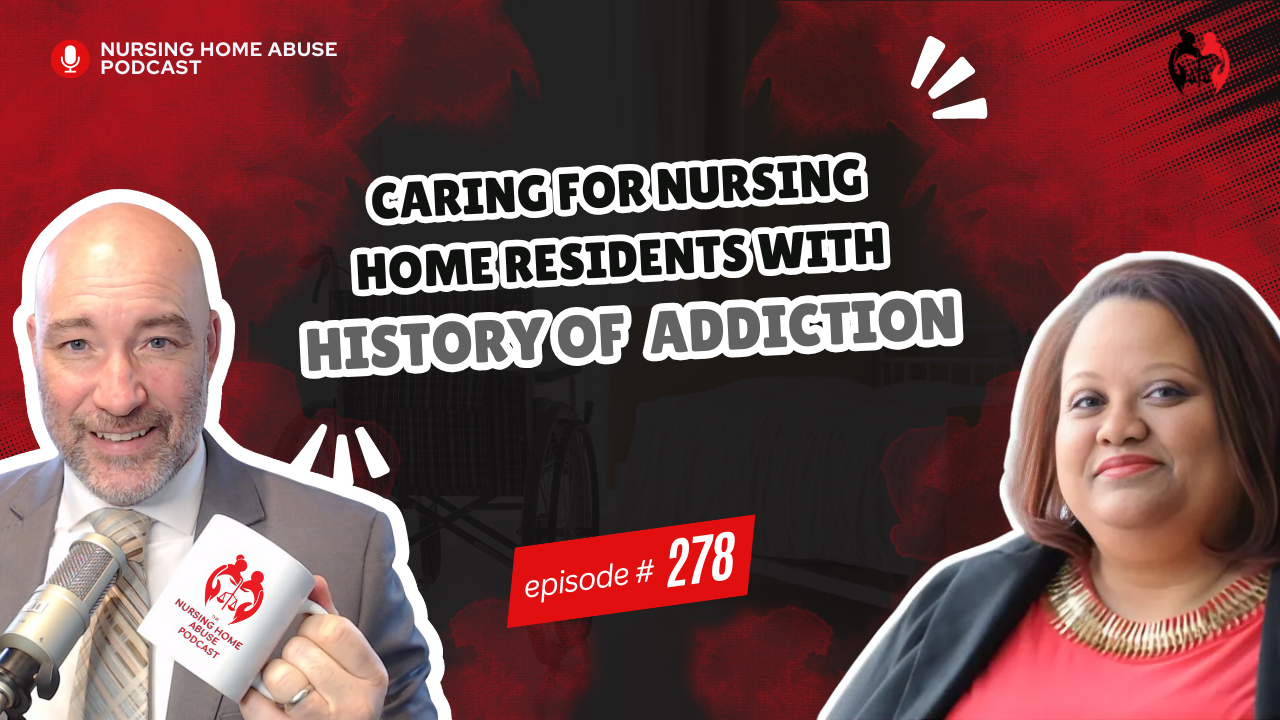


What happens when a nursing home resident has a history of drug or alcohol addiction? These residents face extra risks—and staff often lack the training to meet their needs. Without proper care, relapse or medical complications can occur. In this week’s episode, nursing home abuse lawyer Rob Schenk welcomes guest Tina Baxter to talk about best practices for supporting residents with addiction histories.
Baxter:
But you can imagine that happening in those two instances sticks out, stick outta my mind because I realized there has to be a place for these people to go who need this type of care. But a long-term care, typical unit might not be appropriate. And we need to look at maybe some other solutions that would be more appropriate.
Intro
Schenk:
Hey, out there. Welcome back to the Nursing Home Abuse Podcast. My name is Rob. I’ll be your host for this episode. Today we’re talking about the challenges of caring for nursing home residents that are also recovering, but we’re not having that conversation alone. We have the fantastic Tina Baxter on to walk us through that process.
We have the terrific Tina Baxter on the show. Tina Baxter is a board certified gerontological nurse practitioner and owner of Baxter Professional Services LLC, with over 20 years of nursing experience. She provides legal nurse consulting, wellness coaching, and training for healthcare organizations.
She’s also the founder of Nurse Circle Academy, where she mentors nurses and businesses and national speaker. And podcast host of the Nurse Shark Academy Podcast. Tina has been featured on entrepreneur.com, the minority nurse and other media outlets, and we’re so happy to have her on the show. Tina, welcome to the show.
Visit this professional services page for Baxter Professional Services to explore support and education services related to elder care and legal consulting.
Baxter:
Thank you. Thank you for having me.
What are common addictions requiring treatment in a long-term care setting?
Schenk:
Okay, so I guess straight away the nursing home population would probably not be any different than the population at large. There are gonna be some people that are recovering. In the nursing home, right? What are, in your experience, some of the more common addictions within the nursing home population?
Baxter:
I would have to say alcohol is a very common one, particularly those that have had a long history of alcohol abuse, sometimes it. Leads to some dementia and memory loss and things like that. And then opiate addiction, that is another big one that we see. Particularly because, chronically, people that are in a nursing home oftentimes have a lot of chronic conditions, right?
They’ve had a lot of health issues. And so sometimes there becomes some substance abuse related to prescription medications and misuse and overuse.
This study examines systemic gaps in addiction treatment for older adults in facilities on the impact of preventive health measures in elderly populations.
How are addictions treated in long-term care?
Schenk:
So how, if at all, like how are these things treated? Like how, what is the treatment for someone re that’s, that is an alcoholic or is addicted to opioids?
Baxter:
Oftentimes by the time they get to the nursing home, if they’re acute, obviously we’re gonna have them hospitalized. They’re gonna go to the hospital for detox because we can’t handle that. Level of care in a nursing home, particularly with alcohol or benzodiazepines. There’s a really big risk for seizures and things like that.
But they’re in the recovery phase and we’re gonna do everything we can to keep them in recovery. Monitoring their medication and what they’re taking encourages them if they are still able to get out into the community to attend their 12 step meetings and whatever else that they’re doing. And just being there. To encourage them to maintain their recovery.
Discover how behavioral symptoms in dementia patients are managed on the impact of preventive health measures in elderly populations.
Schenk:
Talk about from a broad standpoint, I guess I never realized that, but what are the phases of treatment? So there’s like literally I guess inpatient for alcohol addiction or whatever it is, and then they leave the inpatient and there’s outpatient and then there’s the programs walk us through that.
Baxter:
So there are several steps that you can come into the continuum for addiction treatment. So what people most think about is the acute inpatient stay and then they think of the 30 day program that we used to have, traditionally we used, stayed in for 30 days. Most places now, we don’t really have a lot of 30 day programs, so it’s usually just acute detoxification where you’re in the hospital and they give you medications to help you come down from whatever you were taking.
So if you were abusing heroin or opiate pain medication or alcohol, they can help you get off of those medications safely in the hospital. Again, there’s a big risk for seizures and other complications when you try to do this cold Turkey on your own. And most people don’t make it through because the pain of the withdrawal sometimes is so difficult, particularly if they have pain medication and opiate withdrawal because the body is sending you pain signal.
So you can go out there and seek more of the medication, and so it comes like this feedback loop. So once you’ve achieved your detox, then we move more towards the recovery phase, and that could be a partial hospitalization program where you go most of your day. To the program, attend classes you get seen by providers, medical providers, maybe even provided medication assisted treatment or we call MAT.
So maybe you’re put on medication like buprenorphine or methadone to help maintain your sobriety. Those could be things that we offer as well. Some will come in and get their Vivitrol which is a brand name, but it’s naloxone, naltrexone that you can get in a. Shot form that helps you with your alcohol or opiate addiction treatment, and you can get that started in the hospital and then we could continue that in the nursing home as well.
This article explores how depression is underdiagnosed and undertreated in long-term care on the impact of preventive health measures in elderly populations.
What are some common challenges caring for long-term care residents suffering with addiction?
Schenk:
That sounds potentially, like a lot. So what are some of the challenges like when you have a nurse, a nursing home resident, and perhaps. That’s, maybe not lucid all the time, for example, like what are some of those challenges getting that addiction recovery treatment to them?
Baxter:
Oftentimes it really depends on the individual client. So if you have someone that maybe has some memory issues, it’s a matter of environment, making sure that. What they have isn’t readily available. I remember we had a resident in the nursing home who had an addiction to alcohol, and he got into the hand sanitizer because it was just readily available.
Nobody thought about it. But it’s one of those things that you have to look at the environment and make sure that it’s safe for that individual. And so there may have to be some changes. So we ended up removing the bottles, hand sanitizer from the wall because of that and put it behind locked doors because we wanted to make sure that he couldn’t get back into it in order to support his recovery.
Episode 39: Can a Nursing Home Be Held Liable for Employee Negligence? explores legal theories behind employer responsibility.
In other cases it could be just a matter of providing that continuing education to the client, to the resident and saying, Hey, this is for your treatment. We’re gonna continue your an abuse for a while. Maybe they’re on BU as a deterrent. That way if they go out into the community, they’re out with family.
Then possibly they could keep them from relapsing. We also will educate the family about some of the dangers of the possible relapse. We had an incident once where the physician was coming into the building and happened to observe the resident sitting in the truck, their truck with their son smoking marijuana.
Learn how medication misuse can be overlooked in nursing homes on the impact of preventive health measures in elderly populations.
And of course the resident denied it, but the doctor’s yeah, I just saw you and I can smell it. And so we educate. Because they may be on medications that will interfere with the marijuana may interfere with their medications. And we’ve had instances of people that have been on marijuana in particular for a very long time that may cause some GI issues and cause hyperemesis syndrome and a lot of people don’t.
Build that. And so because they say it grows organically, so it must be safe. I said there’s a lot of poisons that grow organically too. And so you just have to weigh the risks and the benefits with the individual and do some good education as to why they’re taking what they’re taking and how to take it effectively and safely, and letting the families know that.
If your elders come to visit, make sure that the medications are locked up and in a safe place so they don’t have access to it, particularly if they have memory issues because they may forget they’ve already taken their medication and take it again. And that could lead to disastrous consequences.
This research discusses loneliness and its cognitive impact on elderly residents on the impact of preventive health measures in elderly populations.
What role does the nursing staff play in preventing problems with recovery?
Schenk:
Sounds like the nursing staff or the front line of defense in terms of recovery progress. Like it’s, they get a lot of weight on their shoulders.
Baxter:
They do. And unfortunately in nursing home care, there isn’t a lot taught about how to handle someone with an addiction. So that’s the other piece that needs to be added is helping the nurses understand what it’s like to deal with someone who has an addiction issue, and also if they have a comorbid psychiatric illness as well.
We see a lot of people with chronic mental illness. Are aging out of the psychiatric system, meaning they’re no longer appropriate for the group home because their physical health needs are greater than what the group home can handle. But now they’re placed into a nursing home. And what does that mean when they’re having a psychotic break?
In a troubling example of misconduct, a nurse was caught stealing prescription opiates from patients in a Georgia nursing home.
Coupling that with an addiction issue and those comorbid conditions can make it a little difficult for the staff. And not having adequate training then makes it a little dangerous to have some of these patients in there if you don’t know how to watch out for those risk factors.
Learn how to recognize and fight back against emotional abuse in Georgia nursing homes.
Schenk:
I would imagine too that it’s, it would be like a conflict if and barring anything that’s illegal that the person might be addicted to just stay to alcohol and maybe, depending on what state you’re in, marijuana, where it might be their preference to do it, there’s that conflict.
Baxter:
Yes. And again we look at residents rights. Residents have the right to live their life. That’s their home. And so we tailor that. For example, one of my buildings has a happy hour every Friday. It’s happy hour, but they’re limited to. You get two drinks.
Yeah, that’s it. You can’t get anymore at the happy hour. So if they, now, if they wanna go out with their family and friends and do whatever they wanna do on their weekend, we can’t stop them from that. We can educate them. We had an incident once in the nursing home where. All of a sudden this guy kept falling out of his wheelchair.
If your loved one is in care near Gwinnett County, contact a trusted Suwanee nursing home abuse lawyer.
He just seemed like he was very lethargic and the nursing staff couldn’t figure out what was going on. And so one day he faceplant out of his wheelchair and we figured out it was because he was highly intoxicated. Suddenly he was getting friends from the city that popped up and they were visiting him every day.
Bringing him something he shouldn’t have because he did have an addiction issue and we had to have a conversation with his family. To, because he wasn’t able to make competent decisions to borrow those individuals from the facility because they were contributing to some problems that he was having.
Episode 6: Nursing Home Staffing Abuse addresses how undertrained or abusive staff members cause harm.
Schenk:
Yeah. I could, I can just imagine that being a tough situation particularly when maybe the family’s not as supportive as they should be, where you’re Yes. It’s sad, but if they’re coherent, most of the time you gotta, if they want it, I guess you gotta give it to ’em.
Baxter:
Yes. And unfortunately we’ve had some cases where we’ve had younger people.
Now let’s talk about this because it is happening. There are younger people in your forties and fifties and sometimes even in their thirties, who get admitted to a nursing home because they need to have IV antibiotics because maybe they have a bacterial infection in their heart because they were using IV drugs.
And so now they don’t, they won’t, they don’t wanna keep ’em at the hospital. They don’t need acute care, but they don’t wanna send them home with IV access. So they come to the nursing home for treatment. The problem is unlike a psychiatric unit where there’s a lot of restrictions on who can visit and when, and bags have to be searched, and all those things for safety protocols and long-term care, oftentimes people come in freely to visit.
We don’t check their baggage, we don’t check what they give people. And we had a couple of incidents where people had IV access and actually used illicit substances in the nursing home because their friends brought it in to them. And then we had an overdose situation where we had to get them shipped back out to the hospital.
In Episode 8: Overlooked Signs of Nursing Home Neglect, we identify subtle but serious red flags families should watch for.
And this was when. This is pre COVID, but this is when all of a sudden we had a really big uptake in overdoses and things like that, and people were in the hospital for all these bacterial infections, and the nursing home would say, Hey, we gotta fill these beds, so let’s go ahead and bring them in. And I’m over here as the nurse nurse practitioner and who’d worked in addictions and psychiatry and said, Hey, the nurses really aren’t prepared for this.
Staff isn’t prepared for this. The social worker, which you only have one in the building, they’re not prepared for this. Is this really a good idea? And we got pushback from corporate to say we had to take them. And of course these negative consequences occurred and then all of a sudden they said maybe this isn’t a good idea.
Because you aren’t prepared for that. And then we had another incident where we were younger. The person who was, and with a little mild withdrawal still was on our unit because he had IV access. And on the unit was also our 80-year-old dementia resident. The typical nursing home patient.
Whoever calls out, help me all day. And so can you imagine you are not feeling well. You’re hooked up to IVs, you’re young, you’re stuck in a nursing home next to someone who says, help me, help you all day. You’re already irritable because you just got detox. You’re new into your recovery.
Episode 10: Placing Loved Ones in Nursing Homes helps families navigate the emotional and legal challenges of choosing a facility.
You still, you’re still feeling terrible. And I’m not excusing this young man’s behavior. But he got really frustrated and pushed the elder into the wall in his wheelchair, just she shoved him into the wall. Oh. So obviously, of course we had to get him out of the building as well. And have the other person checked out.
Fortunately, the resident wasn’t. Seriously injured, but you could imagine that happening, those two instances stick out, stick outta my mind because I realized there has to be a place for these people to go who need this type of care. But a long-term care, typical unit might not be appropriate. And we need to look at maybe some other solutions that would be more appropriate.
Schenk:
Tina, are you a podcast host? Is that what I understand?
Baxter:
Yes. Yes. I am a podcast host. I have the Nurse Shark Academy show, where I interview nurse business owners.
Schenk:
Oh, cool. Cool cool. What, wait, what is it called again?
Baxter:
The Nurse Shark Academy Show.
Schenk:
Awesome. Awesome. Okay Tina, I really very much appreciate you coming on the show and sharing your knowledge with us today.
Baxter:
Thank you.
Schenk:
Folks, I hope you found this episode educational. If you have any ideas for topics that you would like for me to discuss, please let me know. If you have ideas for people that you want me to talk to, please let me know as well. Also, please enter to win the Nursing Home Abuse Podcast mug.
Just do it. Stop thinking about it. You’re on the fence. Get off the fence. I need to get rid of these things. I gotta unload a hundred mugs. So just get one new episode of the Nursing Home Abuse Podcast to come out every single Monday. And with that folks. We’ll see you next time.
Tina Baxter’s Contact Information: