



Reducing Falls in Nursing Homes
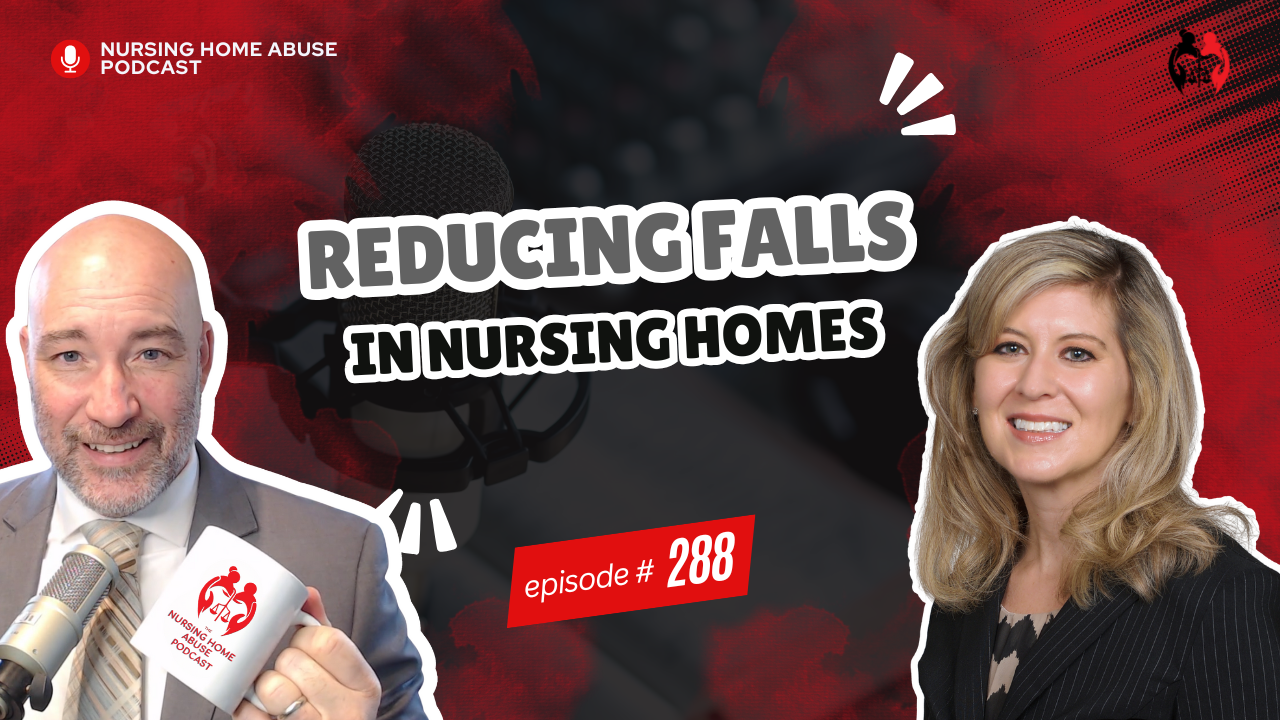


One fall can change everything for an elderly nursing home resident. Hospitalizations from falls are common—and often preventable with proper care. Prevention starts with awareness and planning. In this week’s episode, nursing home abuse lawyer Rob Schenk welcomes guest Laura Chung to talk about fall-related injuries, hospitalizations, and what nursing homes must do to keep residents safe.
Chung:
Toileting schedule again, that is so important. If you’re a family member, you can say, Hey, my loved one’s on a diuretic. They’re on Lasix. Can you put them on a toileting schedule? Polypharmacy. I would go over their list of meds with the PCP and say, Hey, is there anything we can do to minimize the meds they’re on?
Because again, with each medication that they’re on, the fall risk increases.
Intro
Schenk:
Hey, out there. Welcome back to the Nursing Home Abuse podcast. My name is Rob. I’ll be your host for this episode. Today we are talking about falls and fall prevention methods and interventions in nursing homes, but we’re not having that conversation alone. We had the fantastic Laura Bouchard Chung on the show to walk us through this process.
It’s time to get into the meat and potatoes of the episode. Again, fall prevention in nursing homes. We’re gonna be discussing that with the fantastic Laura Bouchard Chung. Laura is a registered nurse who brings 25 years of bedside nursing experience, including roles as an ICU staff, nurse relief charge nurse, and rapid response nurse. She has worked in hospitals across California, Connecticut, and New York City as a travel nurse. In 2020, she launched her legal nurse consulting business and has enjoyed connecting with dedicated advocates in the field.
Laura remains passionate about providing expert care. Clinical insight in both hospital and legal settings, and we’re so happy to have her on the show today. Laura, welcome to the show.
Chung:
Thank you so much for inviting me, Rob.
What are the most common causes of falls in nursing homes?
Schenk:
All right. Off the bat easy question. What are some of the more common causes of falls in long-term care in nursing homes?
Chung:
Sure. So I, I think the top. Item would be toileting. So toileting issues are responsible for almost 50% of falls. And a lot of our older adults, they’re on medications that cause toileting urgency, they’re on diuretics. They might be on blood pressure medicine or blood thinners. All of those medications have side effects.
Discover best practices in Episode 131: Interventions for Fall Risk Prevention in Nursing Homes
That can also cause falls. The first one would be toileting. The second one would be polypharmacy. Polypharmacy is defined as five or more medications, and most of our older adults that are in aging population homes are on at least five medications. So basically the more medications that you’re on, the higher the fall risk.
One recent analysis sheds light on the impact of preventive health measures in elderly populations in reducing adverse outcomes after falls.
Schenk:
It is interesting that you say that. I didn’t know that the toileting is the, if you polygraph the causes is one of the higher, because it seems to me that in a lot of my cases the person will be like resident found on ground, near bathroom, and then if the care plan gets revised, it gets revised like floor mats.
Remember to ring call light to educate residents, but nothing with respect to toileting program. So understanding that toileting is one of the primary causes. It would be interesting that, why don’t we see more interventions for that if the resident is found near the bathroom or, et cetera.
Chung:
Yes. So you hit the nail on the head there, Rob, because a toileting schedule is actually one of the most successful things you can do for older adults and basically a toileting schedule is you are helping them to the bathroom on days. It’s every two hours and on night shift it’s every four hours. And by helping them to the bathroom and doing it ahead of time, you’re preventing the urgency.
You’re preventing them from trying to get up to the bathroom by themselves. Because let’s face it, no one wants to have an accident. That’s one of the most humiliating things that can happen to you as an adult. So a lot of these older adults are. I’ve called for help. Maybe they might be short staffed, they might not have enough help available, and then they take it on themselves to try to go to the bathroom and try to make it there in time, and then often have a fall in the process.
Explore how frailty influences care outcomes on the impact of preventive health measures in elderly populations in long-term care settings.
Schenk:
So what does that kind of look like in terms of the rounding? If we have a toileting schedule or toileting program, and as you mentioned, it’s a certain amount of hours in the day, a certain amount of hours at night. Is it okay, Ms. Johnson, we’ll see you in four hours and if you’re asleep, we’re gonna let you go.
Or is it like, what is the process by which the CNA walks into that room and takes care of that program?
Chung:
So it could be part of the care plan. Each person is unique. So someone with Alzheimer’s might not realize they need to go to the bathroom and they might say, oh no, I’m good.
I’m fine. And then they would. Give the CNA instructions, Hey, even if they say they’re fine, let’s really encourage them. Let’s really talk to them and just say, oh, you know what? I know you think you don’t have to go, but we’re just going to try. And then you have some older adults that you know when they have to go or not.
And you’re gonna give them more leeway in that. But some people, just like kids, you really have to make sure, Hey we just need to try. Let’s go try real quick. If you don’t have to go, that’s fine, but let’s try at least.
Discover risk indicators for adverse events on the impact of preventive health measures in elderly populations to improve fall prevention.
How do fall-related injuries impact older residents’ health?
Schenk:
And so how are you finding in your experience, the injuries related to the falls impacting the residents going forward?
Chung:
So I work in an ICU, so a lot of times I receive residents after they’ve fallen in a nursing home, and we’re dealing with the aftermath of that. And in older adults falls can just lead to a cascade of problems. So with younger people, they might fall, but they wouldn’t have a fracture because they don’t have osteoporosis or osteopenia that a lot of our older adults have.
So then I’ll get an older adult in the hospital who might have had a hip fracture. And in a young person say they did fracture their hip, they wouldn’t have all of the side effects and all of the comorbidities. Whereas an older adult when they’re bedbound, they’re more at risk for developing aspiration pneumonia.
Get actionable advice in Episode 122: Five Ways to Prevent Falls in Nursing Homes
They’re more at risk for developing a pressure ulcer. They’re more at risk for getting a UTI just because of their age, their state of fragility. And one thing I wanna point out too is that once an older adult has fallen, they are much more likely to fall again. So the biggest risk factor for a fall. It was the previous fall.
So once they’ve fallen, they are so much more likely to fall again.
Understand how recurrent falls can be prevented with strategies focused on the impact of preventive health measures in elderly populations.
What are the biggest risk factors for fall-related hospitalizations?
Schenk:
Is that like just a statistic or is it, is there something to that I think you mentioned maybe the thought processes of the person. Like now I’m, I guess now that it’s in my head I’m, I’m doing things that I wouldn’t be doing normally, like second guessing myself walking upstairs.
And that’s what makes it more likely they’re gonna fall. Like how does that work?
Chung:
I think older adults have some other issues that they’re dealing with, two of the other biggest contributors are hearing and vision. So for every 10 decibels of hearing loss, the fall risk goes up.
And a lot of our older adults have more than 10 decibels. So again, this is putting them at risk and then vision impairment. So with any type of vision impairment, they are more likely to fall. Older adults often have cataracts, they have other eye issues, their vision isn’t as sharp. So I think that. They might have a previous fall, but then they have vision issues, they have hearing impairment, they have osteopenia.
So it’s all these things stacked against them. A lot of these they can’t do anything about. They can’t suddenly have perfect vision or perfect hearing. It’s just some of the things we deal with with older adults. So all these things are stacked against ’em.
This JAMA article highlights critical considerations on the impact of preventive health measures in elderly populations affecting elder fall-related injuries.
How can nursing homes improve fall prevention strategies?
Schenk:
With these particular risk factors that you’ve mentioned, what are some of the kind of more common strategies?
What are some of the policies that a nursing home can put into place to reduce that likelihood of fall?
Chung:
Sure. So on admission to a nursing home a fall risk is done. And this kind of gives the nursing home, gives everyone, the nurses, the CNAs an idea of where the resident is. So are they a low fall risk?
Are they a high fall risk? And then this should be reevaluated every three months, quarterly, because with older adults a lot can change in three months. And then some of the other things that we can do. So make sure they’re wearing appropriate footwear. I don’t wanna see people wearing slippers or crocs in the nursing home.
If you’re wondering whether every fall must be prevented by law, read our breakdown: Do Georgia nursing homes have to prevent all falls?
Those are just fall risk disasters. Toileting schedule, again, that is so important. And that’s something if you’re a family member, you can say, Hey, my loved one’s on a diuretic, they’re on Lasix. Can you put them on a toileting schedule? Sometimes it takes us to advocate for them. Polypharmacy. I would go over their list of meds with the PCP and say, Hey, is there anything they don’t need to be on?
Is there anything we can do to minimize the meds they’re on? Because again, with each medication that they’re on, the fall risk increases. And then some other things are wearable devices. So smartwatches nowadays actually have gyroscopes so they can tell if a patient or a resident has fallen. And then there’s some data that we can do some screening.
So besides a fall risk. Assessments, we can put in all the different diagnoses the resident might have hearing vision loss, and it gives us a score and it lets us know if this resident will be more likely to fall or not.
For legal assistance after a fall-related injury, visit our page for a Georgia nursing home abuse lawyer specializing in falls.
Schenk:
And I’m assuming then that with that score, you’re gonna say, okay, you’re a high risk or a low risk, and then I’m assuming that the number of interventions would increase or decrease based on the score.
Chung:
Exactly. So with the score, there’s usually certain interventions that go along with that. And I think one of the things you can do as an advocate for your family member if they’re in an aging population’s home, say you are your mom, she’s worn glasses her whole life, always wearing glasses. And the past two times you’ve come to visit her, you’ve noticed that her glasses are off.
Dive into safety planning in Episode: Fall Risk Assessments and Prevention in Nursing Homes
That’s a huge fall risk factor. So what I would do is have a cute picture. Maybe I’d have my kids draw a picture and say, mom is fully dressed when she has her. Glasses on her hearing aids need to be in because again, that’s another fall risk factor she needs to have appropriate footwear on. And that just helps everyone get a visual and make sure that the CNAs can quickly know what to do with mom.
The nurses know, oh, does she not have her glasses on? We need to get those glasses on her. So those are just really easy interventions, but they’re really great fall prevention measures.
If your loved one suffered a fall in a care facility in Cobb County, our Marietta nursing home abuse lawyer for falls can help assess your claim.
What role does staffing play in preventing falls among residents?
Schenk:
How does staffing or the concept of staffing relate to fall prevention?
Chung:
Oh my goodness. Staffing literally makes all the difference especially with toileting. So we know that toileting is responsible for about 50% of falls. So if you have inadequate staffing patients, residents might try to get up on their own. They’ll fall. If you have adequate staffing, you’re going to be able to keep those toileting schedules. You’re going to be able to get to residents on time when they ring their call light. So it really makes all the difference in the world.
What new fall prevention technologies or initiatives are making a difference?
Schenk:
You mentioned a little bit ago about the watches that have the gyros in ’em. You can tell that they have that, that there are falls. Are these things that common or are these still like cutting edge technology.
Chung:
Yeah, I would say that those are still cutting edge technology.
Some really basic things are keeping beds as low to the ground as possible. So typically in the hospital, in the nursing homes, beds go up and down, so always keeping them in the lowest position possible. There’s also bed alarms. And these have been around forever. We use them to make sure there’s a certain degree of sensitivity, so you can put it on if the patient is just moving or if you want it to alarm when the patient is exiting the bed.
In nursing homes, they have really nice ones where sometimes family members can record their voices, and a voice is always more successful, especially one that they know. Then an alarm. You don’t want a bunch of alarms going off at night. So you can actually record it as a family member and say, mom, it’s Elena.
Understand daily risks in Episode 86: Caring for Nursing Home Residents at Risk of Falls
Please don’t get up. Wait for help. They’re coming. And a resident is much more likely to comply with that because it’s a voice that brings ’em comfort. It’s someone they know. So those are some really basic things. Also, underbed lighting makes sure that there’s adequate lighting in the room when they’re getting up at night.
That can really help as well.
Our Vidalia nursing home abuse lawyer page explains your legal options for suspected neglect or injuries in that region.
Schenk:
What is underbed lighting?
Chung:
So basically just having lights built into the tracks underneath the bed so it’s not so dark. Because we know with our older adults, they get very used to where things are. They like a routine, and this way the lighting isn’t jarring to them, but it just gives enough where they can see where they are, they can see where they’re stepping and it helps them easily find a path to the bathroom.
Explore the services offered by our Dalton nursing home abuse attorney when falls or abuse are involved.
How can families ensure their loved ones are protected from falls?
Schenk:
So you’ve described to a family that has a loved one in a nursing home to advocate on their behalf first by asking about a potential need for a toileting program, but also making sure, making sure the medications are okay. Is there anything else that you would recommend to a family to help reduce the risk of falling in love with their loved one?
Chung:
Yeah I think you had a previous episode with Amy Swinehart and she talked about attending the care plan meetings. And I think this is a great way to advocate for your loved one and just to say to them, Hey I’d like to know what their fall risk score is. And then what interventions are you doing to help prevent a fall?
Because again, with our older population, one fall can just be life changing because it just leads to this snowball of unfortunate events. So we wanna do everything we can to prevent these falls. So I would attend those meetings as often as you can. And this is where my heart breaks when someone doesn’t have a family member to advocate for them. ’cause they’re often.
Learn about legal liability in Episode 42: How Nursing Homes Can Be Liable for Injuries from Falls
Schenk:
Yeah.
Chung:
Lacking that.
Schenk:
Sure. Very well said. And good name drop. We love Amy Swinehart over here. She’s the best. Laura, thank you so much for coming on the show and sharing your knowledge with us.
Chung:
Oh, it was my pleasure, Rob. Thank you for inviting me.
Schenk:
Very good folks.
I hope that you found this episode educational. If you have an idea for a topic that you would like for me to discuss, please let me know. If you have an idea for a guest that you would like for me to talk to, please let me know that as well. New episodes of the Nursing Home Abuse Podcast come out every single Monday.
Be sure to win. Try to win the nursing home abuse coffee mug. Input your favorite Atlanta based hip hop artist. That could be. Who else besides Outkast Goodie Mob. What’s the guy’s name that I’m thinking of? He was on the blurred lines. I can’t believe I’m drawing a blank on this. What’s his name?
He actually helped talk a guy down from the rooftop of a building in Atlanta one year. What’s his name? Oh, lemme look that up. I’m gonna, I’m, and nothing, none of this is getting edited either. We’re gonna, you’re gonna do this with me. He did Atlanta wrapper. Let’s see. Ti I, who I was talking about, ti was actually in a courthouse in Atlanta one year for something that he did.
It was a criminal proceeding. I’m pretty sure it was a criminal proceeding. I don’t wanna get sued for defamation, but I think it was, I think it was a sentencing hearing. Like the judge was gonna be like, okay, should I take leniency on you? And on the way there. Somebody was like, I’m gonna jump off of this building unless it talks me off of the top of the building.
I’m almost positive I’m not making this up. And so like it made ’em look good and some people think that it was staged, had the guy go do that. But anyway, I don’t know if it worked. Also, this could be one of those Mandela effect things that I could be completely making this up. So just go, don’t do any research, don’t look this up.
Just assume that what I said is absolutely 100% factually accurate. Did I say new episodes every Monday? I think I did. So new episodes of the Nursing Home Boost podcast come out every single Monday folks. We’ll see you next time.
Laura Chung’s Contact Information: