



Changes to the ANA Code of Ethics
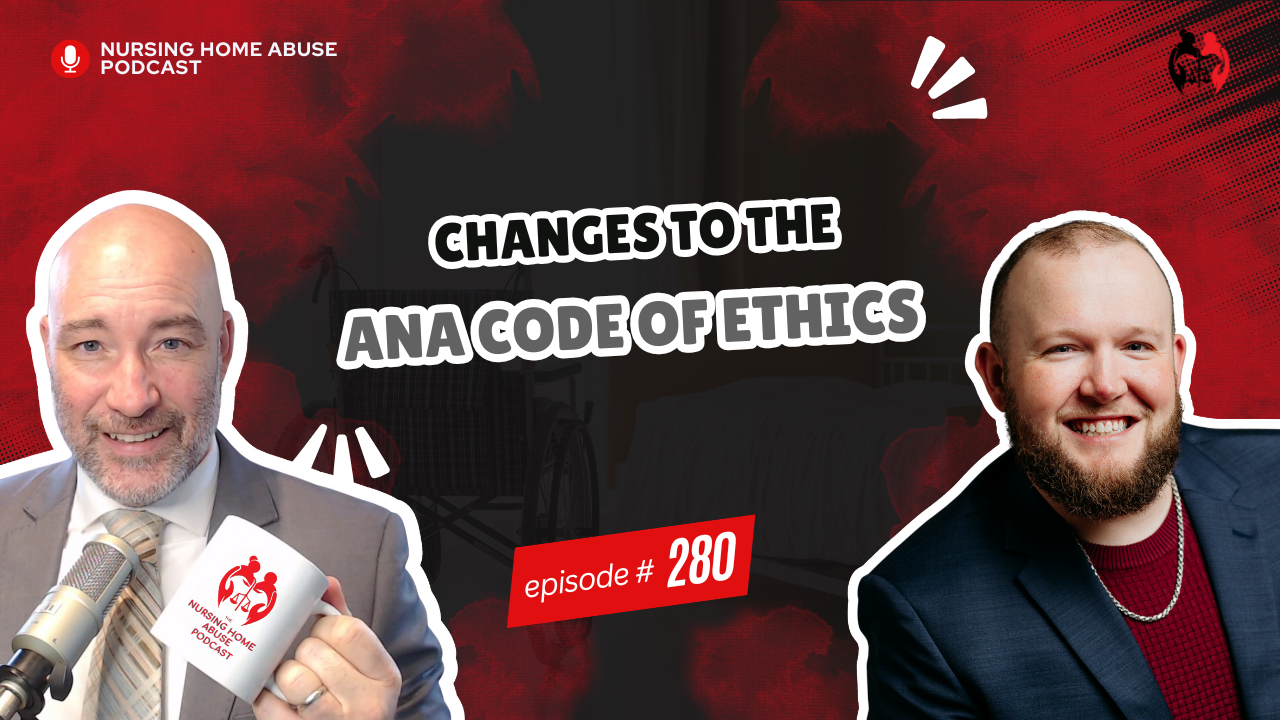


Are new changes to the ANA Code of Ethics shifting the way nurses care for residents? Updates to this critical framework affect how ethical decisions are made in long-term care settings. Understanding these changes is vital for healthcare providers and families alike. In this week’s episode, nursing home abuse lawyer Rob Schenk welcomes guest Matthew Garvey to talk about the latest updates to the ANA Code of Ethics and what they mean for nursing home care.
Garvey:
Nurses have the responsibility to report patient safety concerns, things of that nature that didn’t appear, or that if it did appear, it was more theoretical in the previous additions.
Intro
Schenk:
Welcome back to the Nursing Home Abuse Podcast. My name is Rob. I’ll be your host for this episode. Today we’re talking about the American Nurses Association. Their code of ethics and some recent changes and then some rewind that some changes to the changes. But we’re not doing that. We’re certainly not doing that alone today.
There’s no way I could do that. We have the fantastic Matthew Garvey on to walk us through this process. Now it’s time to get into the meat and potatoes of the episode. Again, we’re talking about the American Nurses Association Code of Ethics and recent changes in exactly what the American Nurses Association is.
We’re not doing that alone. Certainly not. We have the fantastic Matthew Garvey on today. Matthew Garvey, D-N-P-M-B-A. RN is the founder of Garvey Consulting and Education Services with a background in critical care, emergency nursing and healthcare leadership. He brings valuable clinical insight to legal nurse consulting.
He currently works in utilization management, emergency nursing, and as DMP adjunct faculty. Matthew is also pursuing his juris doctor degree at the University of Dayton, which I didn’t know that I should have asked him about. Sorry about that, Matthew. Further expanding his expertise at the intersection of healthcare law.
Matthew does in fact work with attorneys in nursing home cases, providing merit reviews, deposition preparation, things like that. Very knowledgeable guy. Very happy to have him on the show. Matthew, welcome to the show. Hi. Thanks. So glad to be here. All right, so here’s the softball of softball questions for you starting off.
What is the ANA?
Schenk:
Okay. What is the American Nurse Association?
Garvey:
Yeah, great question. So the American Nurses Association is the professional association that represents the millions of nurses around the country, whether they are a member or not. So it is what you would consider a flagship professional organization.
Doesn’t require a certain specialty, nothing of that nature, just. You are a nurse. And they fight for us, right? So they have a lobbying arm, they have an education arm and they just, they essentially just provide resources to nurses, fight for nurses, and then represent the nurses within the United States.
Schenk:
Tell me about the
Garvey:
ANAs code of ethics. Yeah, so the ANA produces a code of ethics. They have, I think, since the 1950s, maybe 1980, somewhere in there. They produce their first one. But essentially, it provides an ethical code for nurses in the United States to follow. It’s one of the only ethical codes that are generalized to all nurses in the United States.
Now, there are several other codes if you look at international organizations and things of that nature. But essentially the American Nurses Association produces this code of ethics. It’s a book. It’s available online for free but you. Also buy a paperback book. They revised it every 10 years.
They actually just revised their code of ethics. So they produced their 2025 revision in January. And as you may be aware they quickly released an error sheet in February and changed quite a bit of language in it. But that code of ethics is really the guiding light of ethical practice for nurses regardless of specialty.
Essentially, regardless of the type of nurse, LPN, RN nurse practitioner whatever nursing specialty they may be. It is the essential guiding light of ethical practice for reg for nurses in the United States.
This study analyzes nurse staffing levels and resident care outcomes on the impact of preventive health measures in elderly populations.
What authority does ANA have over nurses?
Schenk:
If you’re a nurse, it doesn’t matter what you are. You’re in Utah, you’re in Georgia, you’re in New York. Okay. I assume you’re bound by whatever your state regulations are with respect to how you should act. What is the code of ethics? Do they care, is it a guideline? Do you mean like you gotta do it? Are you going to jail if you don’t follow it?
Garvey:
Great questions. So if you correct the standard of practice, the State Practice Act is going to guide the actual practice of nursing in each particular state.
A lot of them look similar, but they differ from state to state. The nursing code of ethics is more of a. More of a guideline? I would say it is more of, I think the a would describe it again I’m not, I don’t work for them. I don’t speak for them, but as an aspirational goal it provides the model conduct.
It doesn’t just relate to care. So it’s not just looking at care at the bedside, but rather the ethical practice of a nurse holistically. So what the nurse should give back to society. Globally, what they should give to a patient, what they should give to themselves, what they should give to their colleagues.
Researchers examine how the Code of Ethics influences patient care decisions on the impact of preventive health measures in elderly populations.
It’s more of that aspirational guide. I will tell you that in years past, before this 2025 revision, it was very. I wouldn’t even say 10,000 feet, probably a 30,000, 50,000 foot view. It was very aspirational, very theoretical. But the 2025 revision gives us a very prescriptive look. So there is a lot of language, there’s lots of language in there about what nurses should do.
That is very. How do I say this? That’s very specific: nurses have the responsibility to put patients in residence before the organization. Nurses have the responsibility to report. Patient safety concerns, things of that nature that didn’t appear, or that if it did appear, it was more theoretical in the previous additions.
Learn how changes to professional ethical standards affect nursing practice on the impact of preventive health measures in elderly populations.
What changes were made?
Schenk:
Okay. That makes sense. Now let’s do this. So there were the recent changes and there was the erota. So tell me like just the top. Couple changes that were made and why you think that. And again, Matthew does not represent the ANA. He has come here out of the goodness of his heart to talk about this with me today.
Okay. So Matthew, what are a couple of the major things that were changed and why did they go back on that?
Garvey:
So I can’t tell you why. That’s one of the things that are, that’s very odd about the entire thing, is that the ANA has been pretty quiet about it. They haven’t really said they, if you bought the book before the changes were made, or you bought the ebook or the physical book, you got an email that said a month later, Hey, here’s the erota sheet.
It was five full. Eight and a half by 11 pages of changes. So quite a bit of change. But they really didn’t say why. Now I can tell you from looking at that erota sheet, a lot of the changes were changing compulsory language, which in the legal field you, we love to talk about compulsory language to very permissive language.
This article discusses the evolving role of nursing ethics in policy development on the impact of preventive health measures in elderly populations.
So there were lots of changes from a nurse to a nurse. Ought to, or a nurse should, which, a lot of the work I do as a legal nurse consultant, both behind the scenes and as a testifying expert, that now creates some ambiguity. And so one of the things that I’m looking at is I’m going to be asked this right in a deposition, if.
The ANA code of ethics is used a lot when it comes to nursing negligence. Just as evidentiary support. Should a nurse have done this? The code of ethics says this, should they have acted in this manner? And so now there are two versions, and there are really no specific statements from the a and a.
So I anticipate being asked in depositions, what, are you aware that their revision was made in January of 2025? Are you aware that there was an erota sheet in February? Why did this happen? Should a nurse act in this way or should they ought to act in this way? I think it creates some ambiguity there that really is going to stump and really change how we can view a nurse’s practice when it comes to expert work.
A review of the ANA Code of Ethics and its guidance for long-term care professionals is available on the impact of preventive health measures in elderly populations.
Why were they made?
Schenk:
Typically what type of case or what type of. Action or intervention are you being asked about in which the code of ethics is coming out as a, Hey, this potentially is, maybe not the standard of care, but maybe illustrative of what the person should have done?
Garvey:
Yeah, I, it really applies to all.
I, in all cases, you can bring it in. I’ve been asked about it in fall cases before. In cases where a criminal where, and this wasn’t a testifying expert work case, but in cases where there is obvious diversion. On behalf of a nurse or obvious neglect on behalf of a nurse and they bring in this code of ethics.
Again, it’s an aspirational code that we should live by as a nurse, that was, that’s what we are told, you would live by this goal. And so it really calls into question, did a nurse act in accordance with it? And if so, not necessarily was it a deviation from the standard of care? ’cause it doesn’t necessarily relate to bedside care, but was it a deviation in what we would expect?
A re a reasonable nurse to do. I will say it’s used a lot as well in administrative law. I’ll say used a lot, but it is a guiding light for that as well in that, when a nurse has a DUI or, and is involved in criminal activity, that violates the code of ethics. And so you’ll see it brought in there as well where. You’ll see some administrative law boards of nursing saying your actions violated their code of ethics that we are held to as a profession.
Read our breakdown of new proposed CMS rules and how they may affect nursing home regulations.
Schenk:
I feel like sometimes you get into that line of questioning where it’s is it is just a guideline or it’s, I don’t have to follow it.
And the question would be then can you disregard it completely? And you’re in an area where you can’t disregard it. But at the same time it’s not something that’s necessarily compulsory. And you’re, and that’s, you’re in like a no man’s land,
Garvey:
Yeah, absolutely. You’re stuck there. Yeah. And that’s what we, that’s what you’re taught as a nurse, that it’s not mandatory. There is no, they have no administrative authority. The American Nurses Association doesn’t. But it is just the same as a treatise that would be persuasive for a court.
It is also persuasive in that manner for nursing. It’s one of those things that the nursing profession looks at and holds in high regard and is very persuasive and determines if a nurse did in fact act reasonably or not. But you’re correct. It has no binding weight. A nurse is not bound by the code of ethics.
A troubling report details how a nurse was caught falsifying health records.
Schenk:
Per se, how often has it changed? You might have mentioned this, so I apologize, but is this something like, is it every 30 years, every two years?
Garvey:
No. So it’s every 10 years and I think that’s written into the bylaws of the ANA, that they will revise it every 10 years.
So I just had a revision for 2025. I will say that when that happens. So you’re looking ahead at what, 2034? When they start preparing for the next one they do a very open public comments time where anybody can come on and give public comments. In fact, I did this time for this revision.
And so nurses, attorneys, family members, patients, anyone public can come online and give their comments. And then the official revision will come out in the January of 20, or this time, 2035.
Learn why the Mandatory RN Bill is receiving strong support from nurses across Georgia.
Schenk:
Are you once you get your certification in whatever state you are for your nurse, your registration whatever you call it, are you automatically enrolled in ANA or is it like, do you have to do, you gotta pay the dues?
Garvey:
Yeah, you have to pay your dues. And that’s a, that can be a source of contention for many nurses is that if we’re held to this book that an organization produces, why do I have to pay to be a part of it? And essentially they fight for you as a nurse. And so that’s the rebuttal to that, right?
If we have to have revenue in order to do the things we do to fight for professional practice. But it is not mandatory. It is a professional organization just like any. A professional organization would be you pay monthly dues or an annual due and then you get the benefit.
How Nurses Are Linked to Nursing Home Quality of Care explores how frontline staff influence resident outcomes.
Schenk:
And who’s the I guess this makes sense. There are elections so that the committee that’s in charge of the code of ethics, I’m sure, there’s a vote to put them in place or whatever. Yeah.
Garvey:
There are several. It’s an entire board and especially whenever it comes to the revision. So in the code of ethics you can see all the members of the board who. Put together, this new revised edition. And then they’re also the, and
Schenk:
They’re getting angry
Garvey:
Emails and angry folks. They are probably, yes, they are getting angry emails, I’m sure of like, why is this changing? What happened? And so there, there’s a board also, the ANA does. They have a commitment to ethics, as part of their infrastructure.
And so both the national and the state chapters have an ethics and human rights committee as well that provide input, that promote the code of ethics, provide education, and so forth.
Elopement and Wandering in Nursing Homes reviews the responsibilities of nursing staff in preventing resident escape.
Schenk:
So what kind of cases are you called to testify in? Like where, what kind of cases are you providing expert testimony for
Garvey:
Sure. So my clinical background is both the emergency department and ICU. It depends, as expert requirements vary by jurisdiction. So in some jurisdictions I can provide both and that is what I still currently do. And so I do provide a lot of expert work. I also have served as a house administrator for a hospital system, multiple.
In Nurse Staffing and Quality of Care in Nursing Homes, we dive into the relationship between staffing levels and preventable harm.
Hospital systems. And so I do some of that work as well. More of the general nursing expert work. A lot of cases that I’m taking right now are falls cases, failure to diagnose in the emergency department, wrongful death in the emergency department. Those cases. I also have quite a bit of experience in patient logistics and transfer center operations.
That is a pretty niche market. Finding an expert who has worked in a transfer center is difficult. True. And so I also do expert work around that as well. A transfer center operations, m patient logistics throughput. Tho those kinds of things.
In Episode 43: The Danger of Nursing Home Elopement and Wandering, we explore legal and clinical risks.
Schenk:
So you’re like a real gunner. That’s what we would’ve said in law school. Like you’re a guy that goes and gets it, does a lot of different stuff, gets good grades. Yeah. Which makes sense that you know about this code of ethics. So let me ask this, and obviously you, how can you know this, so I’m just asking you to speculate, but like how many nurses in this country other than maybe there was a class.
In nursing school or to receive whatever certification. Like it’s not as though they have this book at their house. Like how often are you coming into contact with ANA’s code of ethics?
Garvey:
Yeah, great question. And you’re correct. So in nursing school, actually it may be mentioned maybe. Maybe in your professional leadership course.
It’s rare. It’s very rare that anyone brings it up. It’s rare that I’ve even worked in administration for quite some time. It’s rare that even I, as an administrator, would bring up the code of ethics, saying that as you move higher in academia you do get exposed to it. So the higher you move I have a doctorate degree in nursing in my master’s and in my doctorate.
We did talk about it. Which is interesting because. Most nurses are at the ground level, and so that’s where we should have that information located. What I tell people though is when I offer classes on protecting your license or protecting your practice, those kinds of things, I tell all nurses regardless.
It’s like a, it’s like the law, it’s like the speed limit, right? Regardless of your ignorance of it. Got it. You can still be held to it and so you need to know it’s there, you need to read it. How many of them do after I tell them that? I’m not really sure, but it is, I will say that there probably are.
Episode 75: Preventing Elopement and Wandering in Georgia Nursing Homes discusses prevention strategies and local oversight.
A, a minority of nurses who have actually read it and know what is in the actual code of ethics from cover to cover. Some of them may be familiar with certain provisions of it depending upon things that they’re involved in, unionizing activities, those kinds of things. If they’re involved in any committees within the hospital organization, they may know a few of the provisions, but I would say it’s a minority of nurses who’ve read it cover to cover.
Schenk:
If there are any nurses out there in the audience listening and that you’re a member of the Dirty Dozen that actually listen to this show take Matthew’s advice and read ANA’s code of ethics. But Matthew, we really very much appreciate you coming on the show and sharing your knowledge with us today.
Garvey:
Yeah, absolutely. Thank you so much for having me, and I’m happy to come back.
Schenk:
Folks, I hope you found that episode educational. If you have an idea for a topic that you would like for me to discuss, please let me know. If you have an idea for a person that you would like for me to talk to, please let me know that as well.
New episodes of the Nursing Home Abuse Podcast come out every week. And as always, please make sure that you continue to ignore my desperate please for you to try to win this coffee mug, the nursing home’s coffee mug. My wife is gonna divorce me if I don’t get rid of these two gigantic boxes of coffee cups from my house.
Tell me what your favorite movie is that has won an Oscar. What, there’s so many options. How many years has the Oscars been around? Was Casablanca won? I don’t care. Just tell any movie. Gimme your favorite movie. I’ll give you this mug. I’ll give you two mugs. It can be actually, it could be the Oscar for key grip.
Cinematography. That’s a good one. Any movie, any motion picture can be a home movie. I don’t care. Just put it in there. TikTok at justice for residence. Question of the week video. It’s got Argo on it. Put your answer. Good luck. And with that folks. We’ll see you next time.
Matthew Garvey’s Contact Information: