



Prevention and Treatment of Malnutrition in Older Adults
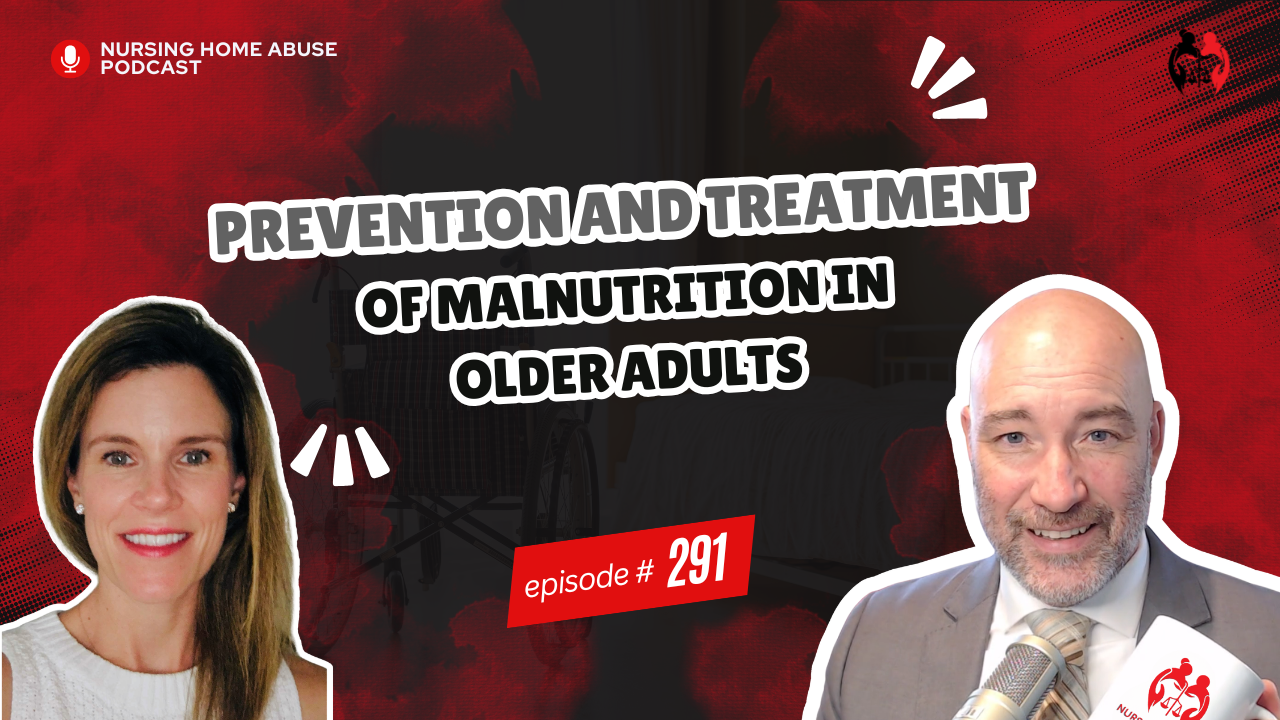


Is malnutrition quietly harming nursing home residents every day? Poor nutrition can slow healing, weaken immunity, and increase the risk of death. Many of these outcomes are preventable with proper screening and care. In this week’s episode, nursing home abuse lawyer Rob Schenk welcomes guest Lisa Moloney to talk about evidence-based guidelines for preventing and treating malnutrition in older adults.
Moloney:
But maybe you notice them dry skin or real pale skin, they don’t quite look like themselves. You might notice a difference in cognitive or physical function. They’re not getting around as well. Maybe they have a wound that’s not healing. So it might be more than just that weight loss.
Intro
Schenk:
Hey, out there. Welcome back to the Nursing Home Abuse podcast. My name is Rob. I’ll be your host for this episode. We are talking all about preventing malnutrition in nursing homes, what malnutrition is what it does to the body and the things that we can do to lessen the likelihood that the residents will get it.
But we’re not having that. That conversation alone, we have the fantastic Dr. Lisa Maloney on to walk us through that process.
And again, as I mentioned, we’re not having this conversation alone. We have Dr. Lisa Moloney on Lisa is a nutrition researcher specializing in evidence-based practice.
At the Academy of Nutrition and Dietetics, she develops clinical guidelines that translate research into actionable strategies for healthcare professionals and policy makers. She earned her PhD in health science from Northern Illinois University where she studied dieticians. Self-efficacy and evidence-based practice.
Professionals can follow industry updates and best practices through EatRightPRO on LinkedIn.
We gotta, we have to make these bios easier for me to say. Dr. Maloney lives in Southwest Chicago with her husband and three children. We’re so happy to have her on the show this week. Lisa, welcome to the show. Thank you so much for having me. I wanna set the table for the episode ’cause we’re gonna definitely talk about what your research has shown, but.
I want us to be on the same sheet of music. When we say the word malnutrition, what are we talking about?
Moloney:
We’re talking about the consequences of inadequate calorie and protein intake. And it could also be due to other factors such as inflammation that can be caused by acute or chronic disease. So it can be a multitude of factors.
So not only intake, but what also is going on with a human body and the consequences that are associated with malnutrition. So it could be loss of physical or cognitive function. It could also be an increased risk of morbidities and mortality, and also an overall impact on quality of life.
Schenk:
So it’s not necessary, it’s not just the compromise in the i in the intake or the deficiency of intake.
It’s the actual symptoms that, or the ramifications of that as well. That’s malnutrition.
Moloney:
Yeah, absolutely. So inflammation has a whole bunch to do with it as well. ’cause it increases your calorie and protein needs. It changes how your body uses your calories and your proteins. It’s a whole system of factors at play.
Recent findings highlight important considerations on the impact of preventive health measures in elderly populations related to nutrition and functional decline.
Why is malnutrition common in older adults living in long-term care or at home?
Schenk:
So why would the elder community or the typical residents of long-term care be more susceptible to malnutrition than other populations?
Moloney:
It could be, once again, we have a lot of factors going on you’re possibly in a new place. You’re not getting, the food and the nutrition that you might be used to at home.
At older ages you might have additional comorbidities, such as diabetes or hypertension, and that could impact your appetite or how your body metabolizes. Foods. It could also be polypharmacy. So you might be taking some medications that change the way food tastes. It could change your appetite.
So among all those factors, it can really reduce your calorie and your protein intake and increase your needs, I think, not to mention your food’s different.
Earlier research offers foundational insight on the impact of preventive health measures in elderly populations in long-term care settings.
Schenk:
Sure. I think that’s a, that is a. A misconception that I get a lot of times from family members when they call me and their loved one is in the hospital, and the doctors are saying that this person, their loved one is suffering from malnutrition.
And the automatic assumption is that they’re not getting enough calories, which could be the case. But oftentimes it’s, as you just described, that it’s not necessarily that ca caloric intake has gone down. Clinical conditions of that resident have made it such that perhaps you can give them twice the amount of calories, but their body is not using the calories.
Moloney:
Yeah, oftentimes I think too that they might not be taking in enough. That’s usually a part of the equation as well. If you’re not feeling well, you’re not hungry. If you think about it, when you’re at home and you have the flu, the last thing you wanna do is eat if you don’t feel good.
So it’s up to hospital staff or like a long-term care staff to check in, see if they’re eating, and what can we do to improve the calorie and the protein intake that’s acceptable to a family member that’s in a hospital?
This analysis addresses systemic risk factors on the impact of preventive health measures in elderly populations affecting older adults.
What are early warning signs of malnutrition in older adults?
Schenk:
Does malnutrition typically presents in a certain way in the elderly community or the long-term care community. Do we have warning signs beforehand?
Moloney:
So if a family member were to go in, so of course if you notice any unintentional weight loss, that’s a huge factor, but sometimes it might just be loss of muscle mass as well. You might notice decreased appetite. Maybe foods are tasting weird if you just start asking questions. Maybe you notice them dry skin or real pale skin, they don’t quite look like themselves.
You might notice a difference in cognitive or physical function. They’re not getting around as well. Maybe they have a wound that’s not healing. So it might be more than just that weight loss.
The Journal of Gerontology provides clinical context on the impact of preventive health measures in elderly populations related to aging and nutrition.
Schenk:
If we’re talking about some of the symptoms of malnutrition being weight loss, perhaps a wound is not healing as fast as it should, then that, I’m assuming then we’re talking about days, perhaps weeks, that malnutrition manifests.
Moloney:
Absolutely. It doesn’t just happen overnight. So as I mentioned before, maybe you’re on medication, maybe you’re not getting the food that you like. Maybe you’re having difficulty chewing. So one thing I forgot to mention, you might notice that perhaps dentures aren’t fitting the way that they used to anymore, and that.
And so you’re trying to wear the dentures and trying to eat, and all these things are manifesting into decreased intake over the long term. So it’s almost like tumbleweed almost. Like it just surmounts and gets, it’s worse and worse unless it’s addressed.
This article examines interdisciplinary approaches on the impact of preventive health measures in elderly populations for improving outcomes in frail elders.
Schenk:
It sounds to me from what you’re describing, that there are a lot of variables and those variables will be, for lack of a better word, variable among each different person.
Moloney:
It’s a hundred percent. It’s individualized. So I, as a dietician I had, I worked in the hospital a little bit before I went into research and I was at, in long-term care. And sometimes I notice. You would go into a patient’s or resident’s room and you would just see these oral nutrition supplements, like stockpiling or they’re getting food that they didn’t like, and maybe they said something to one CNA and then it didn’t get communicated to the kitchen.
It’s just, sometimes it’s just as simple as saying, what are your food prep? Are you having any trouble chewing? It’s you’re getting the chocolate Ensure, but you don’t like chocolate Ensurer. So it’s really just talking to the resident and meeting their needs and their likes and their dislikes and seeing what’s going on.
Learn when poor nutrition may rise to neglect by reviewing our page on malnutrition in Georgia nursing homes.
What nutrition assessment tools work best for seniors?
Schenk:
In your research, do you have a particular nutrition or malnutrition risk assessment tool that you’ve seen work better than others? Or do you have an opinion about that?
Moloney:
Yeah, absolutely. So in research we’re all about definitions and using valid tools. So when a resident comes into a long-term care facility, they have to be assessed within 14 days.
A nutrition assessment or malnutrition assessment. So I am gonna go into the weeds a little bit. But we, in nutrition, we have screening and that’s just determining if an individual is at nutrition risk. And that’s a real, super quick, easy thing. There’s usually three questions. How’s your appetite?
Families in Troup County can seek help from a LaGrange nursing home abuse lawyer.
Have you had any intentional weight loss? And there might be one or two more, but it’s just a get of like, all right, does this individual need to see a dietician? And if that’s the case, if they’re marked as at risk for malnutrition, then the dietician would come in and do a full assessment. They would be looking at the medication.
That they’re taking, they would perhaps do a physical focused exam and really look at the patient and see if there’s any muscle wasting. Ask about chewing and a full assessment to determine if the patient is malnourished. And once the dietician does their full nutrition assessment, they would also use a valid tool.
Residents in Bartow County can explore their legal options with a Cartersville nursing home abuse lawyer.
So there’s things such as the mini nutritional assessment tool, the subject of global assessment tool. So the dietician should be using some form of tool to officially diagnose malnutrition, and based on results of that assessment. The dietician would come up with a nutrition prescription or strategies to address that specific patient to see what works best for them. So any, everyone would have an individualized nutrition care plan.
Schenk:
Now, it sounds to me what you described is that the first pass at the resident for their assessment for risk of malnutrition is by a nurse. And if the nurse flags that resident as a higher risk, then the dietician should get involved.
That would be like the best practices.
Moloney:
Absolutely.
How can long-term care facilities improve nutrition for residents?
Schenk:
I and I guess that this would be a dumb question based on what you’ve described, but if an individual is assessed as a high risk for malnutrition, then the interventions that you would put in place would vary depending on what is placing that resident at risk.
But what are some of the more common interventions for somebody that, let’s say that they are at risk for malnutrition. Because it might be mechanical reasons, like dysphagia, maybe cognitive impairment. What are some of the interventions for malnutrition there?
Moloney:
Okay. There’s different diet textures that you could try out.
You would change the diet order. Maybe they’re just on a general diet and you would change it to mechanical, soft or pureed or and see if that works. Sometimes you would add on oral nutrition Supplements are super common. But like I said, sometimes it gets stockpiled at the bedside, so you would just work and make sure that.
Whoever’s helping them eat. So I guess that’s not something else I didn’t mention. They may need assistance at mealtime, like opening containers, the ensure, perhaps it’s just something as simple as making sure the ensure is cold and giving them a straw, but just meeting their needs.
These little tiny things can really help the calorie protein intake. And dieticians would write these orders. They would talk to staff and do meal rounds and check in and see how they’re doing at those meal times.
This article explains the risks involved when a hospital patient is sent to a nursing home 300 miles away.
Schenk:
Can you tell us like and for the audience. In the show notes, we’re gonna we’ll link to Lisa’s paper that was put out in 2024.
It’s prevention and treatment of malnutrition in older adults living in long-term care or the community, an evidence-based nutrition practical guideline. So if you’re interested in reading that, it’s in the show notes. But Lisa, can you walk us through what brought you to this particular subject, and then we’ll get into kind of the nuts and bolts of maybe your research and what you found.
Moloney:
Yeah, absolutely. So I work at the Academy of Nutrition Dietetics as a nutrition researcher. So we cover all topics. So where the American Diabetes Association, they strictly look at diabetes. We’re at the Academy of Nutrition and Dietetics. We do our best to prioritize topics that are of importance to our members who are dieticians.
And malnutrition among older adults is actually increasing, which is surprising because they can be addressed. With these very feasible strategies, being seen by a dietician and the dietician using their strategies to improve their calorie and protein intake. So as far, what brought us to our conclusion?
So first we looked to see, we did a scoping review, like what’s out there, what research is available. So when we develop guidelines, our guidelines are only as good as the existing research. If there’s no research, we can’t write the guidelines. Otherwise we would be developing consensus recommendations, which are just expert opinions.
For broader context, this resource outlines laws against taking advantage of the elderly.
So based on our scoping review, where we found most of the research was on oral nutrition supplements, food fortification. So that’s when you would bulk up the food. So say for example, you were like to provide. Mashed potatoes, for example. So you, rather than putting like skim milk and passing that on, you would really wanna give it a boost.
So you would add lots of butter, maybe whole milk. How do we increase the calorie needs without having the patient having to increase the amount of food that you eat? ’cause as you get older, your appetite decreases. So that was one strategy. So the oral nutrition supplements, food fortification, and then we also looked at the dietician’s interventions.
Nutrition and mobility challenges are discussed in Activities of Daily Living Assistance in Nursing Homes.
In long-term care, we were pretty bummed out not to see a lot of research there. It just wasn’t available in regards to nutrition set strategies and dieticians in long-term care. So we did call for additional research in long-term care facilities in a discussion of our paper.
Schenk:
I don’t mean to interrupt you, but I wanted to understand like, where are you getting that data? Are you asking the nursing homes to provide it to you or?
Moloney:
Oh, so when we develop guidelines, we first conduct systematic reviews. So we use primary studies that have been published, so maybe like a randomized control trial or an observational studies. So we take our data from studies that have already been published, so we like, we’re like a secondary research level.
Okay. So we collect. All of the research. So all of the primary studies. So like a single trial that was conducted in Chicago or a single trial that was conducted in Boston, we try to take the best available research. We synthesize it, we summarize it, we evaluate the quality of the research. We come up with a summary and then we write our recommendations.
I see. Then once we have our recommendations, that’s when we start to pull and we wanna make sure that they’re practical, they’re feasible, we’re on point. So we do like a focus group where we bring in dieticians who are working in those settings to give us feedback about what the dietician needs to do to implement this recommendation.
So we wanna make sure, we get stuck in our research world and we’re just in the data and what’s been published, but we wanna make sure that they can be applied to real world settings.
Warning signs families often miss are covered in Episode 8: Overlooked Signs of Nursing Home Neglect.
What role do dietitians play in preventing malnutrition in senior care?
Schenk:
So what are the guidelines? What did you come out on the other side of the data that you got? To tell the world.
Moloney:
We said you definitely gotta get a dietician involved. We might be a little biased there, but you do need a dietician’s intervention. Long-term, what I’ve learned throughout this process, long-term care facilities, you have to have a dietician that they’re not required to have a full-time dietician, but they have to either be part-time, full-time, or a consultant.
And the dietician will provide, I believe, a nutrition assessment within 14 days. Sorry, this is a long answer, but it’s something that I’ve learned to get back to. We recommended that a dietician should see everyone in a long-term care facility. What we learned through these focus groups, it’s, it’s, it gets a little tough.
And there’s certified dietary managers that are in long-term care facilities, but they don’t have the same skillset as dieticians do to do these full assessments and nutrition prescriptions, as I mentioned before. So that was our main recommendation. You dietician interventions are effective in treating and preventing malnutrition and long-term care facilities.
So number one, get the dietician involved. Number two oral nutrition supplements are a great strategy for patients in long-term care facilities, but as I mentioned, you need to check in and make sure that. It’s what the patient or the resident really wants. And how are you.
Staffing responsibilities related to feeding and monitoring are explained in Nursing Home Staff and Their Roles – Episode 91.
How effective are oral nutrition supplements for older adults?
Schenk:
And what and what I’m so sorry to interrupt, but what qualifies as an oral supplement that you’re talking about? The in insurer, like
Moloney:
Yeah. Insurer boost. So there’s even like ones that are like juice. I’m like there was a boost freeze. I remember when I was in practice, which is more like a juice rather than that milk, if that’s not what the residents enjoy. So it’s making sure that you’re meeting their preferences because if they don’t, it’s only nutrition if you.
Consume it. You could put as many insurers by their bedside as you want, but if they’re not taking it, it’s not gonna help. That’s true. So just, you said the oral nutrition supplements, but we do reiterate in the paper, food First we wanna make sure that, f. First, let’s try the meals and like what you have at home.
We wanna make sure they’re getting a balanced diet first and then adding the supplement as needed. It’s not the end all be all. We don’t wanna use the supplement to replace the meal by any means. It should be a supplement. So maybe in between meals. Maybe they’re not a big breakfast person and it should come at breakfast, but that’s what the dietician would do.
Like, all right, their intake’s not so great at breakfast. Let’s add the ensure at that point in time and see if we can get the foods that they like at lunch and dinner.
Swallowing risks and diet modifications are addressed in Preventing Choking in Nursing Homes.
Schenk:
I see.
Moloney:
So that’s what I mean by oral nutrition supplements. We also looked at that food fortification that I mentioned. That’s another commonly used strategy.
We didn’t have a lot of data to support it, but it is a frequently used strategy according to the qualitative data that we got, talking to dieticians and what’s generally happening in practice. And that is something too that I think that residents. Also prefer if you don’t enjoy the boost or the ensure, you can bulk up the foods that they’re already eating.
Malnutrition and skin breakdown often overlap, as discussed in Preventing Pressure Ulcers in Nursing Homes.
Schenk:
And you and forgive me, the fortification was, as you’ve described, adding butter or olive oil to mashed potatoes or something like that.
Moloney:
Yeah, exactly. So just boosting up what they’re already eating because you might already have a decreased appetite. You don’t wanna have to eat more food. So how can we increase the calories and the protein and the food that you’re already eating?
Schenk:
I see. Okay. Any other takeaways?
Moloney:
Individualized care. So we, the bottom line that we took away from it, there’s no magic bullet. There’s no one size fits all. You really need to meet the individualized needs of the residents.
What foods they prefer, what times are they consuming most of the foods? How are they feeling overall about the nutrition that they’re receiving? So working with the resident sometimes if you’re, if there’s issues with cognitive ability, reaching out to the families and seeing what foods they prefer.
So getting the dietician in. To make sure they’re, meeting the needs that they’ve determined in the assessment in the first place.
Schenk:
Very well said. Lisa, we very much appreciate you coming on the show and sharing our nods with us. Yeah.
Moloney:
Thanks so much for having me, and please let me know if you have any additional questions.
We have a lot of resources at the evidence analysis library with the Academy.
Schenk:
Fantastic. Folks, I hope that you’ve found this episode educational. If you have an idea for a topic that you would like for me to discuss, please let me know. If you have an idea for a guest that you would like for me to talk to, please let me know that as well.
New episodes of the Nursing M Abuse Podcast come out every single Monday. Be sure to enter to win the coffee mug. Perhaps you like a new hope. A new hope, which technically was Star Wars for a long time till they remade it or re-titled it. Star Wars a new hope. If we’re gonna get technical ’cause I really need somebody to come and get all these coffee mugs.
It’s becoming a major strain with my relationship with my wife. Anyway, I digress with that folks. We’ll see you next time.
Thanks for tuning in to the Nursing Home Abuse podcast. Nothing said on this podcast either by the host or the guest, should be construed as legal or medical advice, nor is intended to create an attorney-client relationship between the host or their guest and the listener. New episodes for now are available every other Monday on Spotify, apple Podcasts, or on your favorite podcast app, as well as on YouTube and our website, nursing home abuse podcast.com.
Again, that’s nursing home abuse podcast.com. See you next time.
Lisa Moloney’s Contact Information: