



Why Wounds Don’t Heal: 5 Clinical Causes
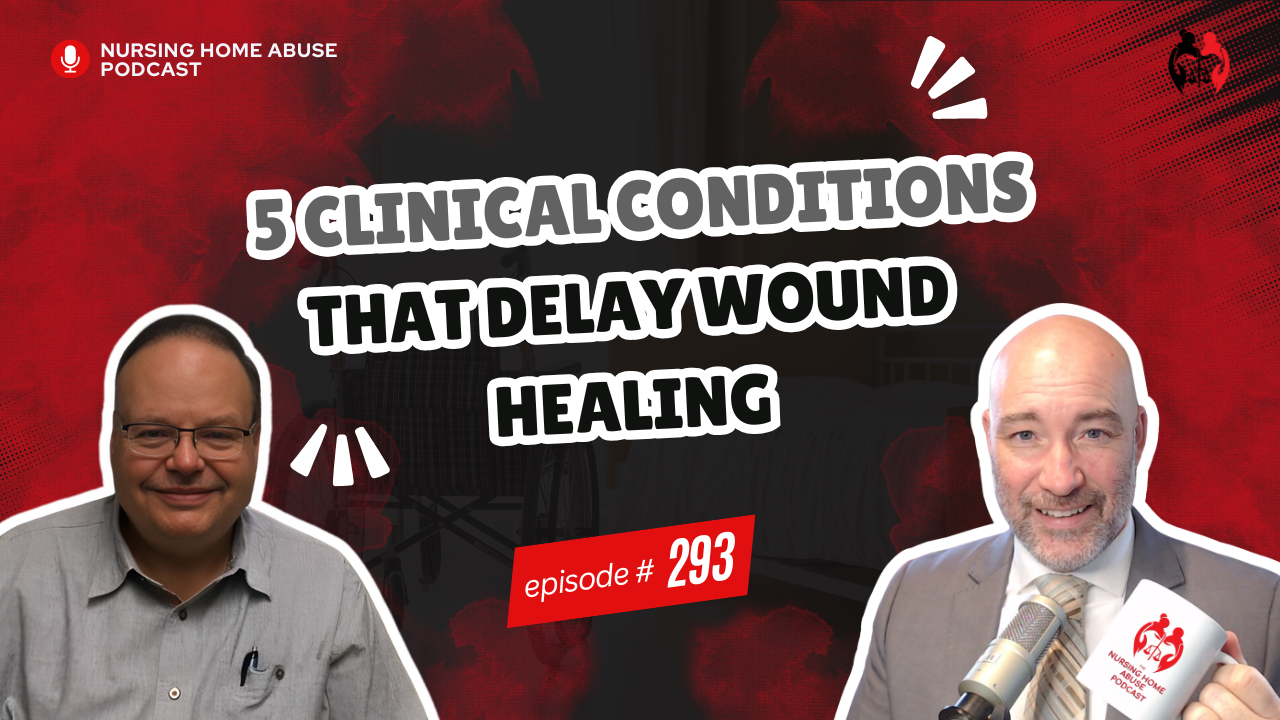


Why do some wounds never seem to heal in nursing homes? Certain medical conditions can slow healing and increase the risk of infection if not properly managed. Nursing homes must account for these risks in care planning. In this week’s episode, nursing home abuse lawyer Rob Schenk welcomes guest Dennis Collins to break down five clinical conditions that commonly interfere with wound healing.
Collins:
And as a matter of fact, it becomes infected so frequently that there is a separate diagnosis under Medicare just for infections of the dialysis catheter and sepsis secondary to the dialysis catheter, as opposed to just sepsis rec secondary from something else.
Intro
Schenk:
Hey, out there. Welcome back to the Nursing Home Abuse podcast. My name is Rambo, and I will be your host for this episode. Today we are talking about. The clinical conditions that are going to impair an individual nursing home resident’s ability to heal an existing pressure injury, but we’re certainly not having that conversation alone.
Today we have Dennis Collins on to talk with us about the clinical conditions that would impair someone’s ability to heal from a wound.
Dennis is a nationally certified legal nurse consultant and experienced nursing educator with over 20 years in emergency and critical care. He has taught at multiple institutions, including Duque University and Community College of Allegheny County, Duque University. See, I had to use Google to tell me how to say Duquesne.
I’d never see it written and it’s spelled weird. Allegheny. I know, like from previous experience, I know about Allegheny. How to say that? Duquesne, that was new to me. Dennis consults on both plaintiff and defense cases involving emergency nursing, Oman Correctional Care, a dedicated medical missionary.
He has led 25 self-funded trips to Central America providing care to underserved communities, and we’re so happy to have him on the show today. Dennis, welcome to the show.
Collins:
Thank you very much. Ready to talk to you today about some issues in wound care.
Schenk:
Very good.
Collins:
I do have some background there. I have been a registered nurse for over 40 years, actually just cut into being a part-time nurse educator.
Now I teach at a local community college in clinical as well as classroom, of course. And started out, my goodness, I started out as a teenage boy, as an ambulance attendant. So this is all I’ve done all my life. I have been an emergency department manager, a case manager, an ER nurse, a flight nurse, did some corrections work.
You pretty well name it. And I have been working as a, on a part-time basis as a legal nurse consultant for about the last 15, 16 years.
What are the top clinical conditions that slow wound healing?
Schenk:
So we’ve laid the foundation that you are highly qualified to speak on today’s topic. I appreciate that. The first thing is this is some people based on their clinical condition are gonna heal faster from a pressure injury than others.
So the $64,000 question is can you walk us through some of these clinical conditions that do have an effect on how long it’s gonna take that person to bounce back?
Collins:
Absolutely. Absolutely. Certainly there’s nothing that affects wound healing. Of any sort really, but certainly of the kind of injuries you’re talking about as diabetes.
Diabetes has profound effects on the circulatory system. It works by dec or doesn’t work by decreasing the circulatory flow to. Parts of the body because of damages to the microcirculation. That’s particularly true in the hands and feet, especially the feet. That’s why you see a lot of diabetic wounds that won’t get better in the lower extremities.
Certainly also really anything that impairs the circulation. And you’ll see people, older people especially, who have a lot of edema intermittently. A lot of swelling intermittently of the lower extremities, and that stretching and contracting of the skin also leads to skin breakdown and makes wound healing very difficult.
This resource examines wound progression and outcomes on the impact of preventive health measures in elderly populations in medically complex patients.
Why do circulation problems, like peripheral vascular disease (PVD) and peripheral arterial disease (PAD), delay healing?
Schenk:
Can you quickly explain why impairment of circulation, what have anything to do with the breakdown of skin?
Collins:
Certainly less circulation to the extremity means less oxygen to the extremity. Blood carries oxygen and a variety of other nutrients to the tissue on the skin, and if it’s getting a lower supply, it just tends to break down.
An analysis of tissue breakdown provides insight on the impact of preventive health measures in elderly populations in long-term care environments.
This is particularly true if you have a point of pressure, a point of that person’s. Body part, contact with something, the bed foot stool whatever like that, a wheelchair perhaps. Common wheelchair related injuries are common like that. And when a person isn’t able to move much, then of course you’re gonna have pressure on that.
Body part that’s against there and you’re going to get skin breakdown. And then because your blood sugar is not well controlled or poorly controlled, then you’re going to get delayed healing in that extremity.
Oral and systemic health interactions are discussed on the impact of preventive health measures in elderly populations affecting vulnerable adults.
Schenk:
I see.
Collins:
Okay. Really, any condition that affects the circulation and logically when your circulation is breaking down, is going to occur the furthest from your heart first, which is generally the lower extremities of the feet.
Schenk:
Which is typically why you might see pressure injuries to the heels, for example, in a diabetic.
Collins:
Absolutely. At 10, people tend to lay on, when they’re in bed, if they’re on their back. Mostly it’s their heels that are against or bearing most of their weight. Yeah. And if they can’t be repositioned and turned frequently and that area isn’t watched, or specific measures taken about that is going to break down first and it just does vary with the individual, but really any, anything that affects circulation is going to affect that, and that’s why you’ll also see diabetic people who maybe what they’ve done is they’ve stuck their toe in the water, in the bathtub or whatever, and they’re not really aware that it’s burning because they have a decreased sensation there.
And so they end up getting burned, and that’s the start of the skin breakdown. Or for that matter, they could have just cut it somehow and they’re not really aware of that even.
Nursing-driven assessment strategies are reviewed on the impact of preventive health measures in elderly populations in pressure injury care.
Schenk:
‘Cause I guess it’s that this, the, in somebody that is cognitively intact, a def a deficit in sensory perception is a risk.
Because if you can’t feel your sacrum or your heel burning, that’s gonna be a problem. You’re gonna be more likely to develop an injury. ’cause you’re not there to be like, oh man, that, that kind of hurts.
Collins:
It is simple. If you stick, if you touch a hot toaster and you have an ECT feeling, you’re gonna pull your finger away.
But if you don’t, you might leave it there for a while. Sure. That’s more or less the same thing.
Broader public-health implications are outlined on the impact of preventive health measures in elderly populations related to preventable complications.
What role does incontinence play in delayed wound healing?
Schenk:
Yeah. Okay. So we got, we have circulation issues, what’s our next heavy bullet point for what would hinder a wound from healing?
Collins:
I would say that incontinence certainly is a big factor and many older people in extended care facilities or even as home patients tend to have a lot of urinary or.
Fecal incontinence, excuse me. And that moisture being against the skin particularly tends to break the skin down if that skin isn’t well cared for, the person isn’t repositioned and so on. Particularly that’s why you see them breaking down or getting some really bad ulcers on the COCC six area.
The bottom is small, the back, the top of the buttocks right there. And that’s why you see that there. You can use, sometimes you can actually see it in a pattern where the person’s moisture would be, most intact, most prevalent.
For interdisciplinary medical-legal consulting services, visit Greater Pittsburgh Medical-Legal Consulting.
Schenk:
And so I guess from just a, I don’t know, like a real basic standpoint, moisture tends to weaken the skin and then Oh, sure.
When and when you’re dealing with. Fecal matter or urine. There are in, there are substances inside those aside from just being moist, that are further weakening the skin.
Collins:
Absolutely. Urine sometimes is quite acidic. It can break down the skin, certainly how bad fecal matter breaks down the skin depends on the diet, if any. And just not trying to be gross, but just laying in that is gonna cause the skin to break down.
Families can better understand wound severity by reviewing bed sore stages with pictures.
Schenk:
Because I think that, at least for me, there’s like a misconception with the family members. That have a loved one in a nursing home when they, you’re explaining this to them, it’s not just about moisture, like when you’re out of the bathtub or you’re out of the shower.
Oh no it’s sweat. It’s that incontinence it’s the, it’s sweat, particularly like it against mechanical equipment, these type of things that people don’t think about. That’s the danger.
Collins:
Then also in that setting, you have to realize that if they’re changing the. Bed or changing, the pads under the person or whatever, and they’re pulling laterally, to move the bedding under that person.
That’s sheer on the skin. That sideways pressure, lateral pressure, can sometimes cause a skin, j skin injury, which in turn can break down.
Schenk:
I see. Okay. Just as a quick aside if you have an incontinent resident and let’s say that, let’s say that the intervention for them, at least for the short term is an adult brief.
Collins:
Okay.
Schenk:
What are some of the things that you’re doing to prevent that? At least. Tamper or lessen how moisture affects the skin you are changing and documenting.
Collins:
This is where I find a lot of it as a consultant, it’s not real documented that this has been done on a regular basis, like what the effect was, how the skin looked at that time.
You’re not, it’s being done occasionally, but not on any kind of a regular basis, and that’s something that you have to look at. I see. It’s better to do it. It’s better to do it every. Few hours, for instance, not better than it is, do it every six or eight. And people also, like I said, when they’re being turned, are they being turned off that pressure area?
Clinicians and families often rely on structured tools like the Bates-Jensen Wound Assessment Scale to track deterioration.
There are mattresses and things that rotate the patient a little bit for you, by pumping up the air and changing the pressure underneath a person and that sort of thing. But, how often is that set to, how often is that being done? How often is the person being evaluated for being incontinent and how’s the skin looking at that time?
I see there are also various sub. There are things like barrier creams and other things like that too that can help, but ultimately they have to be turned into reposition fairly frequently.
When pressure injuries become fatal, this article explains whether a wrongful death claim may exist after bedsores.
Schenk:
So here’s something so you mentioned barrier cream as a potential intervention for moisture. But I guess how do we square that with the fact that if moisture’s bad, why would it be almost quasi moist. Mixture of, be okay. Why would a cream be okay?
Collins:
Because you dried the skin thoroughly first, okay. Of any kind of urine or anything like that. Then you put a.
Given a certain amount of cream on there that is going to form a barrier to those more abrasive things or more irritating things. So if, yes, it is moist and yes, it is chemically and so on and so forth, but it’s providing a. Barrier against more harmful things.
Severe tissue damage may signal neglect, as explained in whether gangrene is a sign of nursing home abuse or neglect.
Schenk:
I see.
Collins:
But that is not a cure all end all, but that is a very good one way to approach it.
Schenk:
So we’ve described conditions affecting the circulation, or at least the ability, the body’s ability to circulate the blood and get the nutrients from the blood. We’ve talked about moisture. What’s next on our hit list?
Collins:
I’m going to say, just, pardon me. Just not turning and repositioning, not being able to move, possibly being against a railing or against the edge of something else on the bed or near the bed.
Those are all factors. If I’m, if my hand is against something for a long time, that’s going to break the skin down. So look for. Things that are done with the person were not done with. The person that can contribute to skin breakdown. Sometimes just being gotten out of bed for therapy or put up in a chair can be injurious, something like that.
Schenk:
So I imagine that. Then things like hemiplegia, paralysis, muscle weakness, these are things that increase the likelihood of certainly pressure injury simply because the person is unable to. Change their own weight, certainly.
Collins:
And if you have, say, a hemiplegia as a result of a stroke, a CVA or something you’re going to have, that’s gotta be a particular area of attention.
’cause the person can’t do anything with that at all. They can’t move that away from what’s irritating. They can’t get off it because something is hurting it really bad. They can’t do it. So you have to pay particular attention to that.
Schenk:
And it’s and it’s really is a truth. Like I, my brother-in-law who at the time was, a physically incredibly fit 30-year-old male who was in a motorcycle accident and he couldn’t move half his body. And he, but the day before, he could bench press four oh pounds, but then he’s not able just. From the sheer weight of half of his body being, outta commission. He couldn’t do these things for himself, like even with the strength that he had for the rest of his body.
So you don’t, in your mind, it’s oh, if I can’t move my leg or I can’t move my arm, like I’m still able to make micro shifts or whatever, that might not be the case at all.
Collins:
Sometimes you can and sometimes you can’t. It just depends on the degree of disability how badly you know, your CVA has affected you.
Sometimes it gets a little better and then you can reposition it somewhat. It just depends. And the same would go for someone with a spinal injury or anything of that nature. Virtually ends up to be the same. Same. You have lost control of some functions of your body.
Nutritional deficiencies often worsen wounds, which is why malnutrition cases are addressed on our page about malnutrition in Georgia nursing homes.
Can certain medications interfere with the body’s healing process?
Schenk:
I see. Okay. So now we have somebody that physically can’t move themselves. What’s our next, what’s the next, I guess this would be the final one we got. We promised the audience five and this will be the fifth one.
Collins:
You’re asking me what would another factor be? I’m sorry.
Schenk:
Yeah. Another clinical condition that would inhibit a wound from healing.
Collins:
Basically anything that is immune compromising. I’ll just use an example. If a patient has cancer and they’re a chemotherapy patient, chemotherapy tends to predispose you to infections, delay wound healing, things of that nature because of its anti-inflammatory nature. Okay, you are on a setup for that.
Certainly. Anybody who’s getting, and this is where nutrition plays a big role also, anybody who is getting inadequate nutrition is. Leading to tissue breakdown particularly with pressure on those areas. If your skint, in other words, if you could, if you would grab the skin on the back of your hand and kind of tent it up and let go of it, it would spring back right away.
Theirs will not because they’ve lost a lot of that tur. A lot of that tone, it’s almost consistent with people I’ve seen in Central America even who are very dehydrated or malnourished. You’ll see that same thing. And that skin is going to break down because it’s not getting all the fluids and nutrients and things like that that it needs to get.
Complex causation issues are explored in Episode 205: Co-Morbidities, Unavoidability, and Pressure Injuries.
What role does protein malnutrition play in wound recovery?
Schenk:
So I guess in terms of malnutrition. What are we looking for? What nutrition would you give somebody who either has a wound or is at risk for developing them?
Collins:
What you’re looking for with the wound is, are they getting adequate vitamins? A, C, and E especially. Okay. And also protein.
Protein is very critical to wound healing. This is why, for instance, if someone has a, isn’t able to take orally or, the dietician should look at them and determine based on their skin wound or whatever, what the optimal. Nutritionist. Okay. The dietician should be able to tell you, okay, we need this much of this vitamin mixture this much water, this much protein.
And there are various ways of delivering that. The most common if the person can’t take it orally or someone can’t feed them is to have a tube feeding. Okay? Unfortunately, what you get into with tube feeding. It’s not really meant for the long term, but what you get into it with is if it’s going in a nasal tube, it’s gonna give you some skin irritation and breakdown here.
Advanced diagnostic tools are discussed in Fluorescence Imaging of Wounds in Nursing Homes.
And if usually it’s through the abdominal wall, if it’s going to be any longer term, it’s gonna give you some skin breakdown there too. But if it’s delivered at the right rate via a pump and the right mixture, it can pretty well optimize the person’s nutrition, especially in the short term. But you have to look at his dietary, seeing them.
Dietary doesn’t make orders incidentally. They make recommendations and the patient physician has to order okay, use that tube feeding. There are so many different kinds of tube feeding mixture. I couldn’t begin to say, but I can think of. Over a dozen right off the top of my head. And some of them are optimized for, say, a burn, or some of them are optimized for just a tissue injury.
Other ones are for people who have pulmonary issues, so it doesn’t cause mucus in the respiratory tract and things like that. Blood sugar, of course there are many for blood sugar, many for people with bad kidneys. You can optimize what is given to the person with a good dietary consultant if they’re following the patient.
Distinguishing wound types is critical, as explained in Differences Between Pressure, Diabetic, Vascular, and Kennedy Ulcers.
Schenk:
I had I knew about protein as a macro for pressure injuries. I hadn’t heard, you said vitamin A and EA,
Collins:
C and E.
Schenk:
A, C and E. And also I’ve heard zinc, but I had not heard AC and e I’ve heard zinc and protein. That was about it.
Collins:
Yes. Zinc is actually sometimes added to a wound healing paste that is applied to the wound area for that same reason.
But AC and EI mean think back historically when people would get scurvy. When they’re old time chips and things, that was because there was no vitamin C in their diet and that would tend to break their skin down and make them ill. So yeah, you do have to optimize your nutrition.
Schenk:
which is also my understanding as to why we referred to the British as limes.
Collins:
I did not know that could be false.
Schenk:
But I think it, it’s one of those things that I’ve heard, but I’ve never verified it. But that’s my understanding is that’s where the term limy comes from, is they always had limes with them for scurvy,
Collins:
or they would look to obtain something with vitamin C. I know the old treatment for scurvy, I mean it was more folklore than anything, was as soon as you got to an island, bury the person up to their necks for 24 hours in the ground and.
Of course that’s not sound or anything like that, but I think it must have got some results at one time because of just what might have been in the soil.
Treatment failures are addressed in Practical Methods for Treating Pressure Ulcers in Nursing Homes.
What challenges do dialysis patients face in wound recovery?
Schenk:
Exactly. So tell me about how we’ve let’s do a bonus clinical condition. So what about dialysis? How does dialysis and renal disease factor into this?
Collins:
Okay. Renal disease basically means that you’re losing your kidney function. Okay? And re the degree of kidney function loss without getting overly detailed, is measured with a lab test called a glomerular filtration rate, or GFR generally, if your GFR is below. 50 for more than a short time. It’s going to be associated with development stage three kidney disease, which then continues.
If the function continues to decline it’s going to get worse, progressively worse. Okay. Dialysis takes these waste products out of the body, runs it through a very sophisticated filtering system, and then puts it back in. Okay. Again. People who have dialysis frequently have electrolytes like sodium, potassium all out of whack, and also have a very high blood sugar because sometimes, unfortunately, diabetes goes with this as well.
Okay? If the blood sugar is not being well managed, if the electrolyte balance is not being well managed, then moon healing cannot occur. Also with dialysis. Unfortunately, when the people aren’t getting it, they tend to get edema in the extremities or the lower back. If they’re on their back all the time, fluid tends to pull back there.
The legal and clinical overlap is further examined in Co-Morbidities, Unavoidability, and Pressure Injuries.
And that contributes to skin breakdown as well. Also the dialysis catheter itself. Dialysis is usually achieved through what’s called an AV shunt in this kind of a setting where they make a connection to your circulation right here. And the blood goes. Out the arterial blood goes out, it’s put back in the venous side.
That’s, hence the name may be shunt, and that device, that catheter, which is surgically implanted. Frequently becomes infected. And as a matter of fact, it becomes infected so frequently that there is a separate diagnosis under Medicare just for infections of the dialysis catheter and sepsis secondary to the dialysis catheter, as opposed to just sepsis rec secondary from something else.
So it is, it is a major problem. And also when you have a dialysis catheter and you’re doing dialysis, you have to maintain proper septic technique at all times. That can’t get dirty, that can’t get anything like that. So that’s a concern too. But poor kidney function of course means, is reflective of poor body function and that’s going to break the skin down.
End-of-life documentation issues are clarified in Do Not Resuscitate: Myths vs. Facts in Nursing Homes.
Schenk:
Very well said. Dennis I appreciate you coming on the show and sharing your knowledge with us today.
Collins:
Sure. It was nice to be here. Thank you.
Schenk:
Folks, I hope you found this episode educational. If you have an idea for. A topic that you’d like for me to talk about, please let me know.
If you have an idea for someone that you would like for me to talk to, please let me know that as well. What was the hint for today? Oh, it was the cheese. Be sure to participate in the TikTok giveaway and win yourself a nursing abuse podcast mug. I think if it wasn’t blue cheese, what is my next favorite Cheese?
I’m just gonna say like aged Vermont white cheddar. Because technically all cheese is white and cheddar is colored with coloring. I don’t know if that’s common knowledge or not. I learned that yesterday. But Vermont H Cheddar, that’s a good one too. Anyway, whatever it is, comments, win the cup, get these cups outta my house.
New episodes of the Nursing Home Abuse podcast come out every single Monday. And with that folks. We’ll see you next time.
Thanks for tuning in to the Nursing Home Abuse podcast. Nothing said on this podcast either by the host or the guest, should be construed as legal or medical advice, nor is intended to create an attorney-client relationship between the host or their guest and the listener. New episodes for now are available every other Monday on Spotify, Apple Podcasts, or on your favorite podcast app, as well as on YouTube and our website, nursing home abuse podcast.com.
Again, that’s nursing home abuse podcast.com. See you next time.
Dennis Collins’ Contact Information: